The Cloud Illusion: Why a Server Location in Germany Doesn’t Guarantee Digital Sovereignty

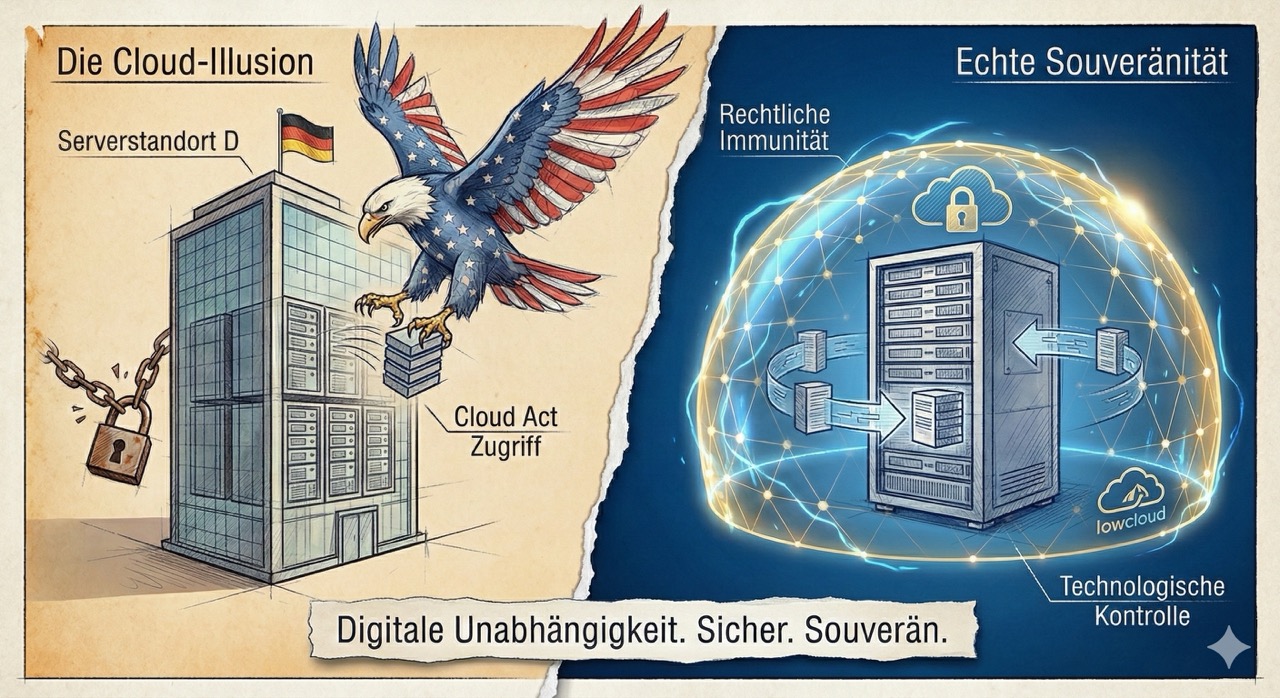
Many mid-market companies in Germany feel they’ve got it covered. The cloud strategy checklist looks complete: data sits in a Frankfurt data center, the provider is ISO-certified, and the contract promises “Hosted in Germany.” But as we explain in detail, data residency is not data sovereignty.
Yet behind that facade, digital sovereignty often crumbles where it matters most: in legal immunity against extraterritorial access and in technological freedom from vendor lock-in.
1. Location vs. Access Control: The Cloud Act Dilemma
A common misconception is that the physical presence of hardware protects data from foreign access. Companies relying on US hyperscalers are subject to the US Cloud Act – even when their data resides in Germany. The law requires US companies to hand over data on request, which frequently conflicts with the GDPR. Since the Schrems II ruling, it has been clear: a server location in the EU or Germany alone does not meet the high bar for data protection compliance.
For a detailed analysis of this legal conflict, read our article on Cloud Act vs. GDPR and the real risks for EU businesses.
Real data sovereignty means — and self-hosted EU alternatives can deliver exactly this:
- Legal immunity: No access by third-country authorities.
- Compliance: Full alignment with European standards.
- Operational control: Full ownership of your tech stack and data.
2. The Overlooked Champions: Why Local Cloud Providers Are Often Underestimated
Germany has a strong ecosystem of local infrastructure providers. These sovereign cloud solutions excel in performance, legal certainty, and personal support. But in practice, IT teams face a major hurdle: developer experience (DX).
While US hyperscalers have spent years setting the standard for managed services and one-click deployments, many local providers have lagged behind on usability. DevOps teams are often forced to choose between:
- Speed and convenience: Use US tools and accept the risk of legal dependency.
or
- Security and compliance: Use local providers, which often means manual configuration, ticket-based processes, and a steep learning curve.
This “DX gap” means developers often push – sometimes unconsciously – toward hyperscalers to keep their workflows fast.
3. The Solution: Maximum Sovereignty Without Compromising Usability
Data protection and modern software development don't have to be mutually exclusive. At lowcloud, we solve this dilemma. We don’t run our own hardware, but add a highly automated abstraction layer on top of sovereign German infrastructure providers. That connects local hardware with global software standards.
Automated deployment: No more manual provisioning or ticket queues. With lowcloud, you provision sovereign resources automatically with a click or via API – as fast as DevOps teams expect from hyperscalers.
Automated management: We reduce your operational complexity. From scaling to lifecycle management, lowcloud automates the entire management layer so you can focus on your application instead of infrastructure.
No vendor lock-in: You stay fully independent: infrastructure lives directly in your provider account, not ours. With our abstraction layer, you can switch between local providers without rebuilding your toolchain.
Conclusion: Time for a Future-Proof Cloud Strategy
Real sovereignty is strategic, not just marketing. Companies that choose cloud infrastructure without US ties protect themselves against legal risk and technological dependency.
Our BYOC approach gives you full data ownership – and lets you deploy as fast as with hyperscalers.
Why Use Containers and Deploy With Them
Containers kill environment bugs, cut deployments to seconds, and use hardware more efficiently than VMs. How they work and where teams trip up.
Infrastructure as Code: Deploy Reproducibly, Not by Hand
Configuring servers by hand is error-prone. With Infrastructure as Code you deploy infrastructure versioned, reproducible and automated — plus an overview of the key tools.