

Deploy Your Vibe-Coded App: Fast, Cheap, EU-Hosted

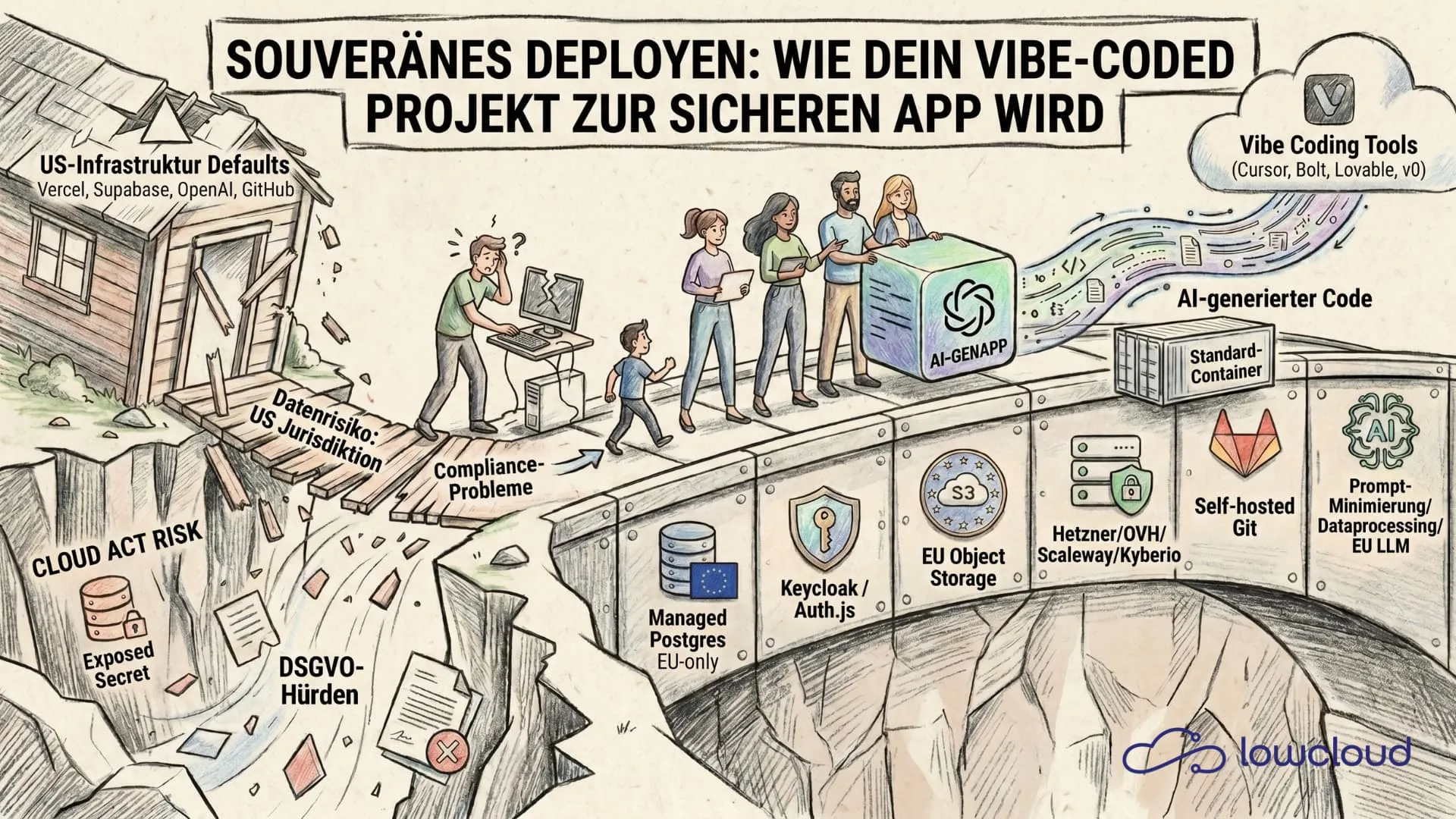
You threw an app together in three hours with Lovable, Cursor and a bit of Claude Code. It runs, it has users, it stores data. On Vercel, with Supabase as the database. You probably don't know exactly where your users' data lives. And that's a bigger problem than you think. If you want to deploy with sovereignty, the best time to start is today, not when the first GDPR request lands on your desk.
The 2026 vibe-coder stack and why it has a compliance problem
What "vibe coding" actually means
Andrej Karpathy coined the term in early 2025, and Merriam-Webster picked it up before the summer was over. Vibe coding means: you describe what you want, the agent builds the code, you test, you give feedback, you deploy. Nearly half of all code written in the world today is AI-generated. That's not a gimmick, that's the new standard.
Karpathy himself now calls it "agentic engineering" — the drift away from blindly accepting toward more oversight. In everyday work, though, what stays is what the tools promise: describe it, hit enter, deploy. Cursor, Replit, Bolt, Lovable, v0 all bet on this flow.
The standard stack: Lovable + Cursor + Vercel + Supabase + OpenAI
When you look at what vibe coders actually deploy, almost everywhere the same picture emerges. Lovable or Bolt generates the Next.js frontend, Cursor refines it, Supabase handles database and auth, Vercel hosts the whole thing, OpenAI or Anthropic provide the intelligence in the backend. GitHub as code storage. All on free tiers, all in under an hour.
That's not just popular, it's a standard architecture with its own tutorials, guides and Fiverr profiles. You no longer type "how do I deploy Next.js," you type "fix my Bolt plus Supabase plus Vercel setup."
Why this stack lands on US infrastructure
Vercel is US. Supabase runs its default region in the US, the EU region is optional. OpenAI and Anthropic are US. GitHub belongs to Microsoft. Even if you sit in Berlin, every API call your app makes goes through at least one US provider. Your user data lives, depending on your configuration, in Virginia, in Frankfurt-but-with-a-US-parent, or both at once.
That's not a bug in your stack. That's its default. And as long as nobody tells you that you can choose, you don't choose.
Default stack vs. sovereign variant, side by side
| Component | Default vibe stack | Sovereign variant |
|---|---|---|
| Frontend hosting | Vercel (US) | Container on EU platform |
| Database | Supabase Postgres (US/EU) | Managed Postgres EU-only |
| Auth | Supabase Auth (US) | Auth.js, Lucia, Keycloak |
| File storage | Supabase Storage (US) | S3-compatible on EU provider |
| LLM inference | OpenAI / Anthropic (US) | EU provider or prompt minimization |
| Logs and monitoring | Vercel + Datadog | Platform's built-in monitoring |
| Code storage | GitHub (Microsoft, US) | GitLab self-hosted, Codeberg, Gitea |
| Payment | Stripe (US) | Mollie, Adyen, Klarna |
At first glance the right column looks like "do everything yourself." It isn't. Most components exist as a managed service with the same convenience as their US counterparts, just under European sovereignty. You swap the provider, not the workflow.
What you're processing as a vibe coder without knowing it
Personal data from the first login
The moment your app has a login, you process personal data. An email address is personal. An IP address is personal. Browser fingerprint, device ID, auth token, all personal. You don't need a banking app for this. A login page with "Sign in with Google" is enough.
GDPR doesn't distinguish whether you're a hobby project or a corporation. It distinguishes whether you process personal data. If you do, the same obligations apply.
Embeddings, chat histories, log files
Vibe-coded apps almost always have an LLM in the backend. With it you pull in more data categories: chat histories, embeddings, prompts. Embeddings aren't an anonymized vector but a potentially traceable fingerprint of the content. If you persist chats, you persist what the user told you, including everything they'd have been better off not saying.
Log files are what many forget completely. Vercel logs request headers. Supabase logs SQL statements. Your LLM provider logs prompts. If even one of them logs more than necessary or longer than necessary, that's a GDPR problem.
Why your hobby project might need a DPIA
Anyone processing personal data with AI may need a Data Protection Impact Assessment, a DPIA under Article 35 GDPR. Sounds like corporate compliance, but it also applies to solo devs when the processing risk is high. A chatbot app that sends user queries to OpenAI and stores the answers falls under it fast.
If you have no DPIA, no records of processing, no clear list of sub-processors, you're not "not quite there yet." You're behind.
The CLOUD Act problem for your app
How US providers can be forced to hand over data
The CLOUD Act is a US law from 2018. It lets US authorities demand that US companies hand over data, regardless of where the data physically sits. Frankfurt, Dublin, Singapore, doesn't matter. If the provider is US, it falls under it.
This isn't a theoretical scenario. The order can come with a gag order, meaning neither you nor the provider may inform the user. So you might be processing data right now that's already being handed over in the background, and you'll never find out.
Why "EU region" at a hyperscaler isn't enough
AWS Frankfurt, Azure Germany, GCP Belgium, Supabase EU region, all use physically European data centers. But the contracting party sits in the US. Contracting party means legally responsible, and therefore subject to US law. The EU region is a data location, not data sovereignty.
The EU-US Data Privacy Framework of 2023 defused the transfer problem but didn't solve the CLOUD Act problem. It's legally patched, structurally open.
What happens when a customer notices
As long as you're a hobby project with only friends-and-family users, little happens. The moment you have B2B customers, every other contract starts with a compliance questionnaire. Where is data processed? Who is the data processor? Sub-processors? If you then answer "Supabase, Vercel, OpenAI, Anthropic," you just booked yourself a long meeting with the customer's data protection officer.
The day your side project becomes a problem
The first GDPR request from a user
A user writes: "Please delete all my data." You have to be able to prove where data about this user lives everywhere, and that you've deleted it everywhere. In Vercel logs, Supabase tables, OpenAI prompts, Stripe records. If you can't document that in a coordinated way, the request is an open front.
The first audit request from a B2B customer
A mid-sized company from the healthcare sector wants to buy your service. Its data protection officer sends a 40-page questionnaire. The second question is about sub-processors. The fifth is about a transfer impact assessment. The twelfth asks whether a US provider is involved. You can either answer honestly and lose the deal, or hope nobody checks.
The first authority request or pen test
A data protection authority asks a routine question. Or a security researcher finds an exposed Supabase service key in your frontend bundle — that's a documented standard problem of vibe-coded apps. Both are not hypothetical: studies found more than 2,000 vulnerabilities and 400 exposed secrets across over 5,600 publicly available AI-generated apps. If that's your app, you no longer have a choice, only damage control.
What "deploying with sovereignty" actually means
EU infrastructure outside US jurisdiction
Deploying with sovereignty means the contractual relationship with the hosting provider is under European law and the provider itself is not subject to US jurisdiction. That's more than a data location. It's ownership and legal authority.
Concretely: providers registered in the EU, whose parent company sits in the EU, whose infrastructure stands in the EU. Hetzner, OVH, Scaleway, Kyberio are examples. The same requirements apply to the app platform on top of them.
Standard containers instead of proprietary platform lock-in
If your app only runs on one platform, you also have a political dependency. A US provider can change its terms, kick you out, get patched. With standard containers and standard Kubernetes your app stays portable. You can move it to any compliant provider without changing the architecture.
Database and state in the same sovereignty space
If your frontend sits in Frankfurt but your database is at Supabase US, your sovereignty is gone anyway. The weakest link in the chain sets the level. Database, auth, file storage, logs all have to come along.
How to do it without losing the vibe
Push-to-deploy stays. Only the hosting changes
The good news: you don't have to break your workflow. lowcloud and comparable platforms keep the push-to-deploy pattern. You push to GitHub, a container gets built, a preview URL appears. Exactly like Vercel. The difference isn't the flow, it's where the result lands.
Container setup for your AI-generated Next.js
Your Lovable or Cursor output is usually Next.js. Next.js runs in standalone mode in a standard Docker container. A minimal Dockerfile is enough.
That's all. With that, the app runs on any container host. On a sovereign platform just like on Vercel.
Managed Postgres instead of the Supabase US region
Supabase is Postgres at its core. You need Postgres and a bit of auth and storage. Both exist managed on European platforms: Postgres with one click, auth with standard libraries like Auth.js or Lucia, object storage S3-compatible. Migration is one pg_dump and a few connection-string changes away.
For the LLM part: there are European inference providers. If you stay on OpenAI, you at least know what you're doing — and you can minimize the prompts before sending, instead of forwarding user data unfiltered.
What you gain, beyond compliance peace of mind
Clear data flows, clear invoice
One contract instead of five. One invoice instead of four. One log stream instead of three. Anyone who has ever tried to trace the data flow through Vercel, Supabase, OpenAI and Stripe for a data protection authority knows what that's worth.
Migration with a clear head, not in a panic
You migrate either when you have time, or when a customer applies pressure. The latter is always more expensive. Whoever learns to deploy with sovereignty early has done the process cleanly once and can then focus on what vibe coding is actually good at: building fast.
Credibility with B2B customers
Compliance questionnaires have become a selling point. Anyone who can say "EU provider, no US sub-processor, documented DPA" gets through every procurement process the US competition fails. That's not marketing — it's a direct sales advantage in the mid-market and the public sector.
A checklist to get started
If you want to start pragmatically, go in this order.
- List your sub-processors. Every service your app calls. Write it down.
- Mark every US provider. Those are your migration candidates.
- Identify what data lives there. Emails, passwords, content, logs, embeddings.
- Prioritize by sensitivity. Auth and database first, logs next, code storage last.
- Pick a sovereign replacement per category. Container hosting, managed Postgres, S3-compatible storage, EU LLM or prompt minimization.
- Migrate in small steps. Database cutover with logical replication, no big bang.
- Document everything in a record of processing activities. That's a GDPR obligation anyway.
This isn't a six-month transformation. For a typical vibe-coded app it's a long weekend plus two weeks of shadow operation, where you run both environments in parallel and then make the DNS switch.
If you don't act now
You have two options. Either you wait until a user, a customer or an authority forces you. Then you migrate under stress, with lawyer appointments, without bargaining power. Or you do it now, with time and a level-headed architecture. The second variant costs a few weekends. The first costs reputation, possibly revenue, and almost certainly nerves.
lowcloud is a European container platform that keeps the push-to-deploy flow but combines container deployment, managed Postgres and stateful deployment on European infrastructure. One-click deployment, no DevOps effort, built-in monitoring, the vibe stays, the sovereignty comes with it.
You built an app in three hours. Take two hours so it doesn't blow up in your face in two years.
Platform Engineering: Ship Faster Without Ops Tickets
What platform engineering is, how an internal developer platform speeds up your deployments, and how to start small without building a whole team.
Sovereign Cloud Checklist for SMEs: What Counts
Use this 12-point checklist to assess your cloud for GDPR, NIS2 and real data control, so you can make informed decisions without costly mistakes.