OB7 Case Study: Website Deployment Without Infrastructure Overhead

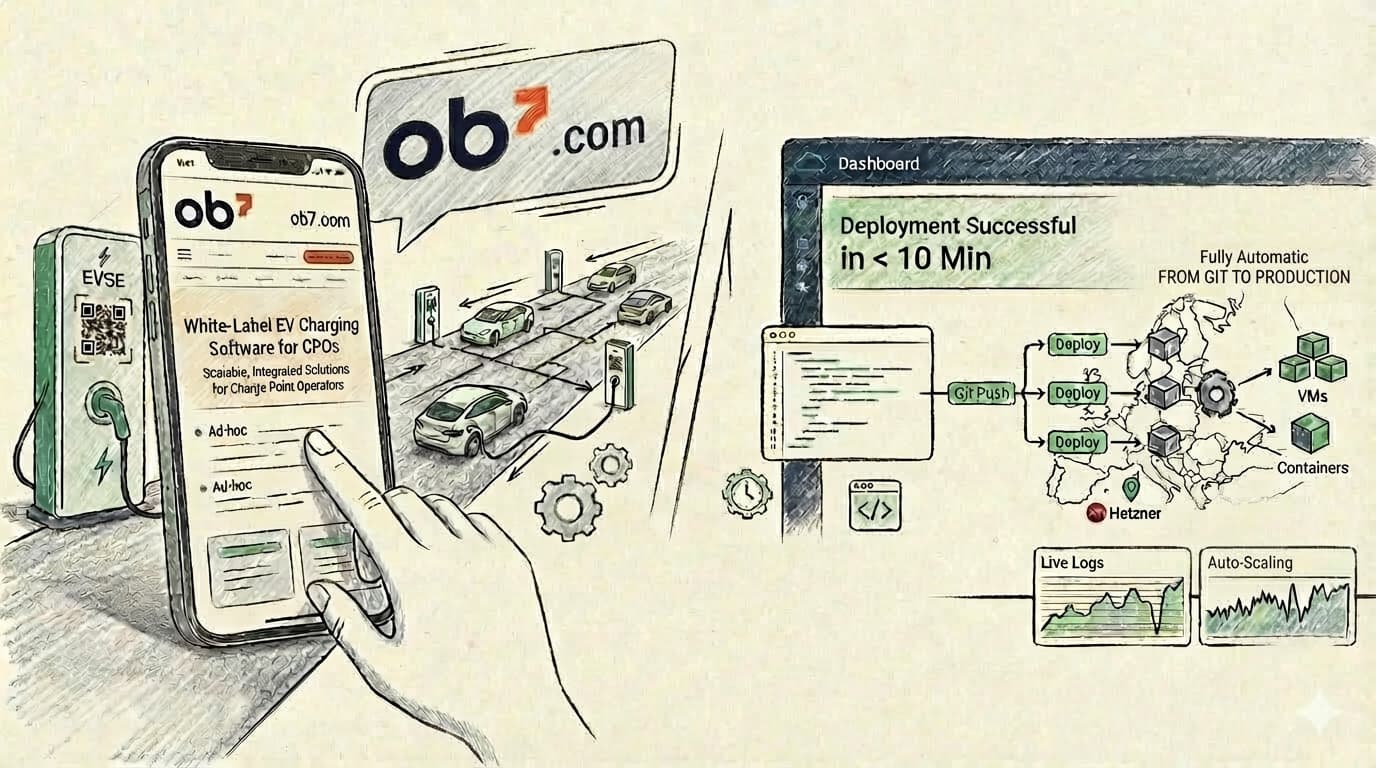
OB7 Deployed Their New Website with lowcloud. Without Worrying About Infrastructure.
Why a team of experienced developers would rather build than configure servers
OB7, based in Dortmund, Germany, develops white-label EV charging software for utilities and charging infrastructure operators. The team has the expertise to set up their infrastructure entirely on their own. But that's exactly what they didn't want to do anymore.
"We just wanted to deploy," says Jörn Depenbrock, founder of OB7. "We know how to build containers. But why should I deal with SSL certificates, webhooks, and servers when I could be working on my product?"
The Real Pain Point: Time Is Limited
The team at OB7 has set up infrastructure plenty of times before. They know how it's done. But at some point, the question arose: Is this really the best use of our time?
Every hour spent on server configuration is an hour taken away from the product. Every SSL debugging session comes at the cost of new features. And every late-night maintenance window is a night not spent improving the platform.
The math is simple: building containers is part of the product — that makes sense. But everything around it? There are better solutions for that.
"Container Image, and You Handle the Rest"
That's exactly the expectation Jörn had when he came to lowcloud. No interest in YAML files, Kubernetes configs, or late-night server maintenance. The requirement was crystal clear: OB7 delivers the finished container image, lowcloud does the rest.
And that's exactly how the workflow looks: connect the container registry, configure the webhook, deploy. That's it. No additional steps, no additional configs, no additional clicks.
What lowcloud Takes Care Of
lowcloud handles everything between "code is done" and "website is live." Fully automated.
It starts with server provisioning: as soon as the container image is ready, the servers are too. No manual setup, no ticket to the cloud provider, no waiting for provisioning.
SSL certificates are automatically issued and renewed. No manual Let's Encrypt setup, no cron jobs for renewals, no monitoring whether the certificate is still valid.
With every GitHub push, a webhook fires and a new deployment rolls out. No custom CI/CD pipeline, no infrastructure configs, no deployment scripts to maintain.
On top of that, there's load balancing and traffic routing. Just there, easily configured, just running.
"SSL provisioning is flying, image pulls work, webhook is running — perfect!" Jörn wrote after the first deployments.
Why OB7 Uses the Managed Service
OB7 could have gone with Bring Your Own Cloud. Their own cloud accounts, their own provider relationship, full control over the infrastructure layer. For many teams, that's exactly the right approach.
But Jörn deliberately wanted the opposite: no Hetzner account to manage, no invoices from cloud providers, simply zero contact with the infrastructure layer.
That's why OB7 chose lowcloud's Managed Service. In practice, this means: lowcloud hosts on German and European providers — in this case, Hetzner. OB7 doesn't have to worry about the account, provider contracts, or infrastructure compliance. lowcloud handles all of it.
The result is zero infrastructure overhead: no server maintenance, no provider communication, no on-call for infrastructure issues. OB7 focuses entirely on their product, and lowcloud takes care of everything else.
And it all stays GDPR-compliant and hosted in Europe. Exactly what matters in the regulated e-mobility sector. Just without the hassle.
Where lowcloud as a Platform Is Headed
Deploying OB7's website in a container was just the beginning for lowcloud. Our goal is to become the standard for modern cloud infrastructure in Germany.
In concrete terms, that means: more scalability, more resilience, more automation. Kubernetes runs under the hood, but users only see what they need to. The complexity stays with us; the simplicity stays with the customer.
Long-term, we want to offer managed services for everything development teams need: not just container deployments, but also databases, monitoring, and logging. All managed, all GDPR-compliant, all in Europe.
At the same time, Bring Your Own Cloud remains an important option. For teams where full control over their infrastructure matters — their own cloud accounts, their own provider relationships, their own compliance documentation — BYOC is exactly the right fit. lowcloud orchestrates the deployments, but the infrastructure belongs to the team.
Both approaches have their place: Managed Service for teams like OB7 who don't want to worry about anything. BYOC for teams that need maximum control. Both on the same platform, both with the same workflow.
And then there's AI. Already, we're seeing more and more teams building AI-powered applications. Apps that work with LLMs. Services that run agents in the background. All of this requires infrastructure that scales, that's secure, and that doesn't come from the US.
lowcloud aims to be exactly that platform. For European teams that want to build modern software without having to worry about infrastructure.
About OB7
OB7 develops white-label EV charging software for utilities and charge point operators. The platform enables ad-hoc charging without registration, white-label driver apps, and cross-charging networks. Currently in use at Stadtwerke Stuttgart and Energieversorgung Oberhausen.
About lowcloud
lowcloud is a European DevOps platform for teams without dedicated DevOps engineers. Deploy containers on your own infrastructure, GDPR-compliant, without vendor lock-in. Long-term, the platform for AI-powered applications and services in Europe.
Kubernetes Monitoring: Using Logs and Metrics Effectively
How logs and metrics work together in Kubernetes, where they differ, and what a solid monitoring stack needs to deliver in practice.
DevOps in SMBs: Why Missing Roles Become a Real Risk
SMBs without a dedicated DevOps role risk outages, knowledge loss, and technical debt. Learn why this happens and what actually helps.