Hetzner Kubernetes Hosting with lowcloud

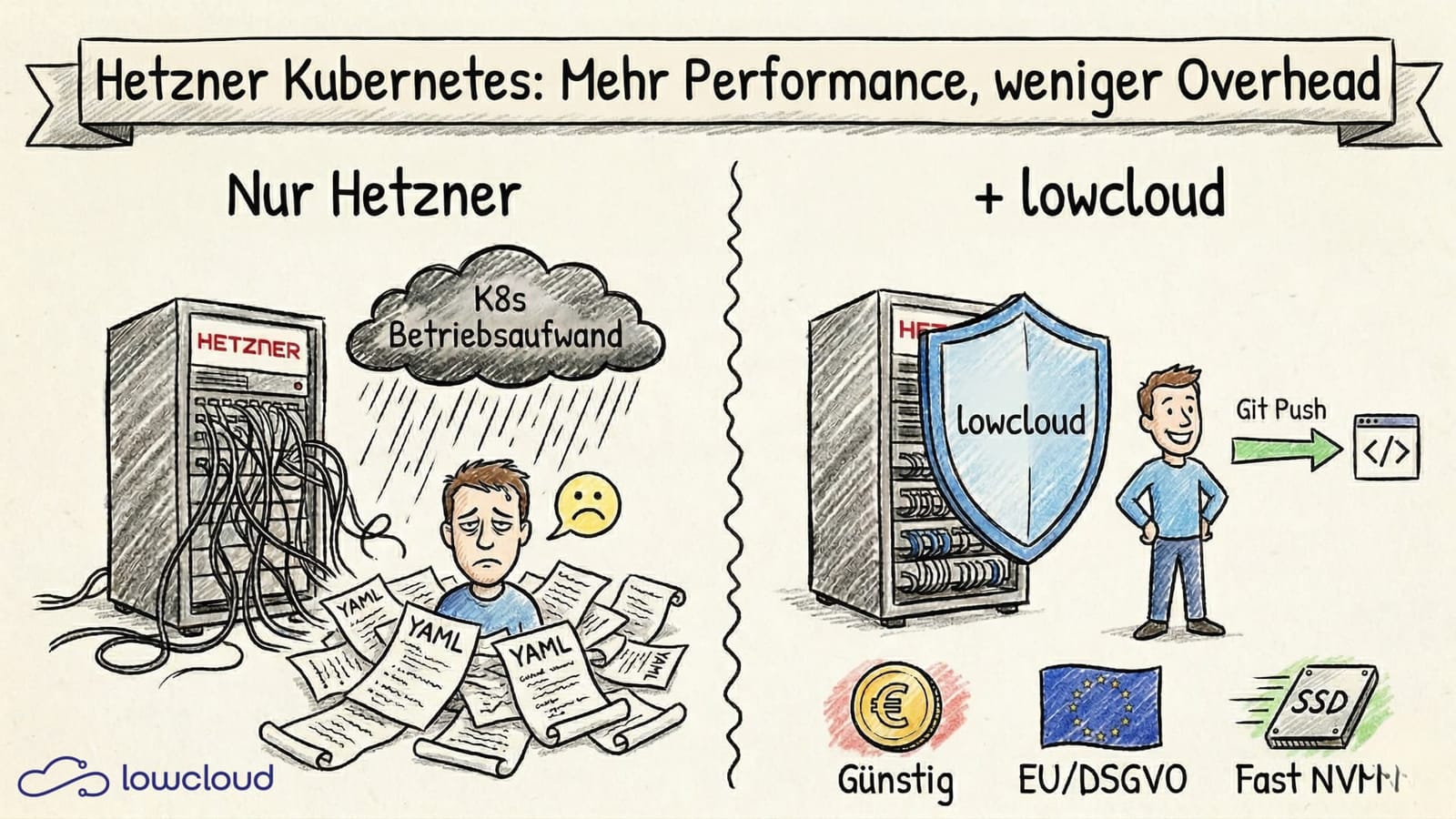
Hetzner is no longer a hidden gem among developers and DevOps teams. The German data centers, NVMe SSDs, and above all the pricing have led many teams to migrate away from AWS or GCP. What Hetzner doesn't provide is a ready-made platform. Running Kubernetes on top of it means setting up, maintaining, and upgrading clusters — and that takes time most teams don't have.
lowcloud fills exactly this gap. The platform builds on Hetzner infrastructure and abstracts Kubernetes operations to the point where developers can simply deploy their applications without worrying about cluster lifecycle or node management.
Why Hetzner?
The answer is usually: cost and reliability. A dedicated server with 32 CPU cores, 128 GB RAM, and NVMe storage costs a fraction at Hetzner compared to equivalent instances on AWS or Azure. Cloud VMs (CCX types) offer dedicated vCPUs without noisy-neighbor issues — that makes a difference for latency-sensitive applications.
Then there's the geographic location. Hetzner operates data centers in Germany (Nuremberg, Falkenstein) and Finland. For teams in the DACH region, that means low latency and, more importantly, data processing and storage within the EU without detours.
Sustainability is another factor: Hetzner powers its data centers with renewable energy. For teams that need or want to meet ESG criteria, that's no minor detail.
The Problem with "Just Hetzner"
Hetzner provides VMs and dedicated servers. Everything built on top is up to the team. That's both the strength and the problem.
Setting up Kubernetes yourself isn't rocket science, but it is work. kubeadm, network plugin, ingress controller, cert-manager, monitoring stack, log aggregation — hours pass before a production-ready environment is standing. Weeks pass before it runs stably and updates work without downtime.
# What you need to consider with your own cluster:
# - etcd backups
# - Node upgrades
# - Control plane HA
# - Network policies
# - Ingress configuration
# - TLS certificates
# - Monitoring and alerting
The real question is: Is this a core competency? For most product teams, the answer is no. The focus is on deploying code, not managing Kubernetes.
Why Teams Still Run Kubernetes "Somehow"
In practice, many product teams lack both the time and the deep operational know-how to set up Kubernetes properly and keep it stable over months. Day-to-day work consists of feature development, bugfixes, support, and releases — infrastructure topics get pushed back until something breaks.
This often leads to two typical patterns:
- "Quick & dirty" in-house: A setup is cobbled together on the side, often without clear standards for updates, backups, monitoring, or security. As long as it runs, nobody touches it — until an upgrade, a certificate, or a node issue suddenly becomes a production blocker.
- Outsourcing to externals: Agencies or freelancers set up the cluster and maintain it on an ad-hoc basis. This can help short-term but creates dependencies. Knowledge stays outside the team, response times depend on the service provider, and every change becomes a ticket.
The bottom line: Kubernetes isn't just a technical topic — it's an organizational problem. Without dedicated ops roles or a platform layer, operations permanently consume focus that most teams actually need for the product.
What lowcloud Contributes
lowcloud is a DevOps-as-a-Service platform that runs Kubernetes on Hetzner infrastructure. This means product teams get the cost advantages of Hetzner without the operational burden of a self-managed cluster.
The platform handles:
- Cluster setup and updates
- Network configuration and ingress
- TLS certificates (automatically via Let's Encrypt)
- Workload scaling
- Monitoring and logging infrastructure
What the developer controls is the application itself.
What a Deploy Looks Like
The workflow is intentionally simple. A team connects the Git repository, defines environment variables, and deploys. No writing Kubernetes manifests. No wrestling with YAML depths.
For teams using CI/CD, it integrates into existing pipelines. GitHub Actions, GitLab CI, CircleCI. A push to main triggers the deploy, and lowcloud takes care of rolling updates without downtime.
What lowcloud Manages vs. What the Developer Controls
This is an important distinction. lowcloud is not a complete black-box system. It provides visibility into logs, metrics, and deployment status. What it eliminates: having to worry about the underlying Kubernetes layer. The platform keeps the cluster up-to-date and stable — that's the deal.
Hetzner Kubernetes Hosting: Cost Comparison
Concrete numbers: A typical setup for a mid-sized web application with three services, staging, and production easily costs 400–700 euros per month on AWS EKS or GKE — infrastructure alone, without operational overhead.
The same setup on Hetzner with lowcloud comes in at a fraction of that. Hetzner VMs are significantly cheaper than comparable instance types at hyperscalers. lowcloud charges a platform usage fee, but the total price stays well below the alternatives.
For startups and growing teams, this matters. It means working in a production-ready environment early on without spending a disproportionate share of the budget on infrastructure.
GDPR and Data Sovereignty
This isn't a marketing argument — it's a practical one. Anyone processing personal data — and that's virtually every SaaS application — must ensure that data is processed and stored within the EU or that appropriate contracts with third-country providers are in place.
With Hetzner as the infrastructure base and lowcloud as the platform, operations stay within European jurisdiction. No data transfers to the US, less hassle with standard contractual clauses, and less need to explain to the data protection officer why customer data sits on servers in Virginia.
For teams in the public sector, healthcare, or finance, this isn't optional.
Comparison with Alternatives
Anyone looking for affordable, simple hosting also considers other providers. A brief comparison:
Render and Railway are easy to use and good for smaller projects. But they run on US infrastructure, which is a problem for GDPR-sensitive workloads. Costs also scale quickly with growing traffic.
Fly.io offers interesting global distribution but no European data sovereignty by default, and the pricing structure is less transparent.
Managed Kubernetes on Hetzner itself (Hetzner Cloud with k3s or k8s) is possible, but you carry the operational burden yourself. lowcloud takes exactly that off your hands.
The key difference: lowcloud combines European infrastructure with a complete PaaS experience (built on Kubernetes). That's a niche other providers either don't occupy or don't prioritize.
Conclusion
Hetzner is a solid foundation for teams that want to control costs while staying in the EU. The problem has long been that you had to build on this foundation yourself. lowcloud changes that.
If a development team should focus on product development rather than Kubernetes operations, this combination is worth a close look. The cost savings compared to hyperscalers are real, GDPR compliance is built in, and the deployment workflow is as close to modern PaaS platforms as possible.
Try lowcloud on Hetzner infrastructure, in European data centers, without Kubernetes overhead.
Kubernetes vs. Docker Swarm: Key Differences and Why K8s Won
Kubernetes and Docker Swarm compared: architecture, scaling, networking, and storage. Why Kubernetes became the standard and when Swarm still makes sense.
MinIO Alternatives Compared: RustFS, SeaweedFS, and Garage
Looking for a MinIO replacement? We compare RustFS, SeaweedFS, and Garage — S3-compatible, self-hosted, and license-friendly for Kubernetes production use.