Vercel vs Netlify: The Difference – and When lowcloud Fits

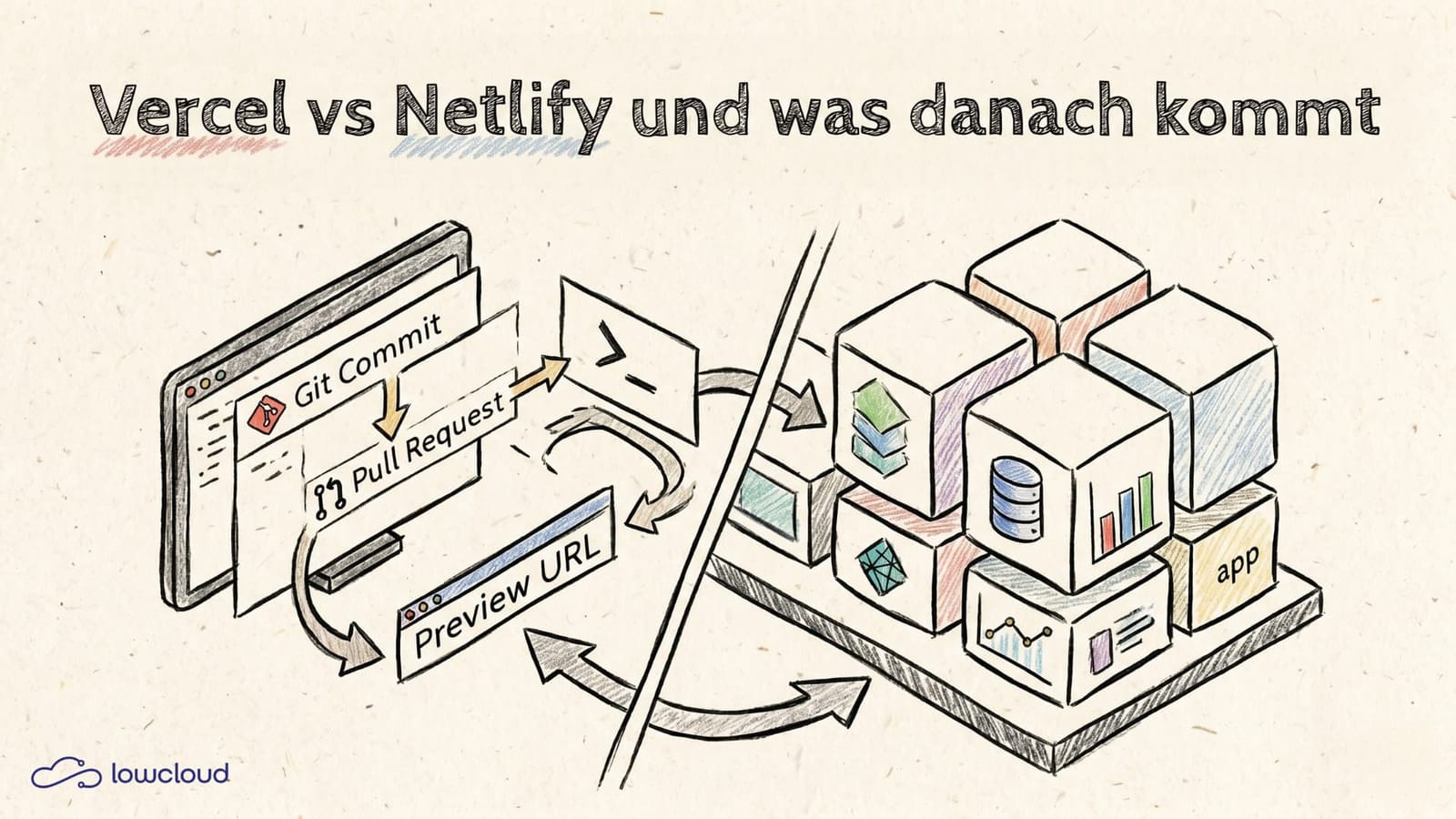
Vercel vs Netlify: What's the Difference – and When Does lowcloud Fit Better?
When you've just built an app, you want to see it live as fast as possible. That's exactly why Vercel and Netlify often feel like "magic": connect a repository, start a deploy, get a URL. The challenge rarely lies in getting started, but in the phase that follows — when a small project turns into a product and state, background jobs, integrations, and costs all have to stay manageable.
This article frames Vercel and Netlify so the differences become understandable even without prior knowledge. On top of that, it looks at when a container-based approach like lowcloud (sovereign, one-click, full-stack) can be a pragmatic alternative.
The Decision in 60 Seconds
Netlify is often a fitting choice when you mostly run static sites or "mostly static" setups and the architecture leans toward frontend plus an external API. The developer experience is strong and the ecosystem is broad, while full-stack requirements often have to be filled in with additional building blocks.
Vercel is especially natural for Next.js applications and modern web apps with serverless and edge functions. Preview deployments are very mature and the workflow is consistently optimized for this approach. At the same time, the model brings platform-specific concepts with it, and costs can become somewhat less intuitive as usage grows.
A container-based approach like lowcloud is a good fit primarily when applications are meant to run as full-stack containers (e.g., a web app plus API, workers, and a database connection), when sovereignty (such as hosting in Germany) matters, and when you want greater portability versus proprietary platform features. In such setups, the focus is often on straightforward operation of stateful components as well as monitoring and operational functions — without the runtime model of serverless functions strongly shaping the architecture.
For pure landing pages, the decision in practice often comes out in favor of classic static/Jamstack hosting. When Next.js is at the center and the serverless/edge model is a deliberate choice, Vercel is often the most direct path. When it's foreseeable that, beyond HTTP requests, you'll also need background work, databases, file uploads, or long-running processes, a container/PaaS model can be a natural alternative.
What Vercel and Netlify Have in Common
Both platforms are built so that hosting doesn't feel like hosting. Typical shared characteristics are:
- Git integration: Code pushes automatically trigger build and deploy.
- Preview deployments: Pull requests or branches get their own URLs, which simplifies feedback and review.
- CDN & SSL: Content is delivered globally; domains and certificates can be managed with little effort.
- Env vars / secrets: Configuration isn't hardwired into the code.
- Rollback: Switching back to earlier deployments is possible.
For many projects this is the decisive relief: getting started without your own VPS, SSH setup, or web server configuration is realistic. At the same time, it's worth understanding the respective operating model to avoid surprises later on.
The Decisive Differences: Runtime Model, Limits, and Dealing with "State"
The biggest difference lies less in the UI and more in the question of which runtime model is actually being used.
Serverless/Edge vs Container – What Does That Mean in Practice?
- Serverless/functions (typical for Vercel, also Netlify):
- A request starts a function that ends again after processing.
- Billing is heavily usage-based (requests/compute/duration).
- Suited for spiky traffic and "API light."
- Less suited for long-running processes (workers, queue consumers, WebSockets) or very long jobs.
- Edge runtime (especially relevant on Vercel):
- Code runs closer to end users and can be very fast for simple logic.
- The runtime is deliberately restricted (different APIs, different assumptions), which means not every library works without adjustments.
- Container (e.g., lowcloud):
- Applications run as containers and behave comparably to a classic process, but managed.
- Long-running processes, background jobs, WebSockets, and larger dependencies can often be modeled more straightforwardly.
- Deployment stays closer to standard mechanics (Docker, 12-factor configuration).
In short: serverless is a different operating model than containers. Both approaches can make sense, but they solve different classes of problems.
Developer Experience: Why Vercel Often Feels "Smoother"
Vercel is historically and culturally closely tied to Next.js. This shows up, for example, through:
- established patterns for SSR/ISR, routing, and image optimization,
- a very clean preview workflow,
- defaults tailored to modern web apps.
Netlify is more broadly positioned and strong for static sites and Jamstack across many frameworks, but often feels less "Next.js-first" than Vercel.
Rule of thumb: For Next.js deployments without much configuration, Vercel is often the fastest path.
Debugging: Where Time Typically Gets Lost
In everyday work, the difference shows up less in the happy path and more in edge cases:
- With serverless/edge, limits such as execution time, memory, cold starts, and filesystem/network restrictions play a bigger role.
- Some problems are platform-specific: a setup works locally but not in the edge runtime.
- Container setups are often easier to reason about because the application runs closer to a "normal process."
This doesn't mean containers are always trivial — but troubleshooting tends to be less exotic.
Costs: Why "Cheap to Start" Doesn't Automatically Mean "Cheap to Grow"
Comparing entry-level prices is understandable but incomplete. The major cost drivers often only emerge as you grow, for instance through:
- Build minutes and concurrency: many builds and preview deployments, parallel team workflows,
- Traffic: requests and bandwidth,
- Serverless compute: not just frequency, but the duration of execution,
- Observability: logs, traces, and metrics (often limited or available as an add-on),
- Add-on products: KV/blob/queue/DB offerings or external add-ons.
A typical growth pattern often runs through auth, payments, webhooks, background jobs, uploads, and finally the desire for databases with backups and clear SLAs. Then a "deploy button" turns into an ecosystem of services. At this point, the central question is whether you want to assemble a platform ecosystem or whether a full-stack deployment model with clear responsibilities for state and services fits better.
Full-Stack Reality: Databases, Jobs, WebSockets, Files
Many full-stack requirements concentrate in practice on four areas.
1) Databases: "The Truth Has to Live Somewhere"
As soon as an application goes beyond static content, data storage becomes central — regardless of whether you use Postgres, MySQL, or Redis.
- With Vercel/Netlify, it's common to run databases externally (a managed DB at a provider of your choice).
- This makes topics like latency, secrets, migrations, backups, and access models important.
- With short-lived runtimes (serverless), efficient connection management also becomes relevant (pooling, limits).
2) Background Jobs: "Not Everything Is an HTTP Request"
PDF generation, transcoding, batch imports, newsletters, or synchronizations are typical background tasks. Serverless can become awkward here depending on the platform, because long runtimes are expensive or limited and retry/queue handling adds extra effort. Container-based setups often allow a straightforward worker process that consumes a queue without fighting against the runtime model.
3) WebSockets and Persistent Connections
Realtime features like chat, collaboration, or live dashboards are widespread. Serverless is only partly suited for this depending on platform and architecture; containers can typically model such connections more directly.
4) Files/Uploads
Uploads, avatars, and exports require storage. Platform-native blob/storage products can be convenient, but they bind you more tightly. S3-compatible storage is often more portable.
Vendor Lock-in: How Expensive Is a Move?
Vendor lock-in is less an ideological topic than a risk and effort factor.
- With "frontend plus standard API," migration is usually feasible.
- With deep use of platform-specific features (edge APIs, proprietary KV/blob/queues), migration becomes significantly more expensive.
- Container deployment is fundamentally more portable: a Docker image can (with adjustments) run on multiple target systems.
A pragmatic approach is to use platform features where they save substantial time, but keep core logic as portable as possible.
Sovereignty & Compliance: A Dealbreaker for Some Teams
For many projects the hosting location is uncritical; for others it's a hard constraint. Typical requirements are:
- hosting in specific regions (e.g., Germany/EU),
- clear contractual foundations (including a data processing agreement),
- auditability and access control.
If you plan to address customers in regulated environments later, it pays to measure the hosting model against these conditions early — a short-notice move after the first enterprise deal is often expensive and risky.
Recommendation by Usage Scenario
Solo Projects and Quick Prototypes
Here, momentum and the lowest possible overhead often matter most:
- Next.js-first: Vercel is often the obvious default option.
- Static sites or simple web apps: Netlify is often a very good fit.
- Foreseeably many background jobs and stateful components: a container approach can make sense early on.
Small Teams (Roughly 2–10 People)
Here, preview deployments, cost control, and debuggability become more important:
- Vercel is strong in Next.js-heavy teams.
- Netlify fits well when the frontend is at the center and APIs run externally.
- With many worker/cron/queue/DB components, a container/PaaS model can reduce the number of additional building blocks.
Products with SLA, Growth, and Customer Requirements
As maturity increases, other factors become dominant: monitoring/alerting, backups/restore, reproducible deployments, predictable costs, and compliance. In this phase, a container-based PaaS is often the less surprising solution.
How lowcloud Can Address This Pragmatically
lowcloud is designed for situations where applications shouldn't be assembled from many individual services, but should instead run as a full-stack in a consistent operating model. In practice that often means:
- One-click container deployment: deploying containers instead of platform-specific functions.
- Stateful focus: databases and stateful components are core use cases.
- Monitoring & operations: logs, metrics, and health checks are directly relevant.
- Sovereignty: hosting in Germany can be an important factor.
- Less lock-in: containers as the standard make portability easier.
This isn't a "Vercel is bad" argument. Vercel is very well suited for certain workloads. The decisive point is that with long-running processes, jobs, DB-heavy workloads, or compliance requirements, a container model is often more straightforward.
Conclusion: The Operating Model Is the Central Decision
The most important question is less which dashboard looks better, and more which operating model fits: serverless/edge or container. From that, the choice often follows automatically:
- Netlify: strong for (mostly) static and Jamstack.
- Vercel: strong for Next.js and serverless/edge.
- lowcloud: strong for full-stack containers, sovereignty, and more predictable operations as you grow.
Dokploy vs Coolify: Which Tool Fits When?
Coolify vs Dokploy compared: architecture, deployments, databases, security and operations. A pragmatic guide to choosing the right self-hosting tool.
Why Use Containers and Deploy With Them
Containers kill environment bugs, cut deployments to seconds, and use hardware more efficiently than VMs. How they work and where teams trip up.