
Ship Fast: Sovereign Cloud Providers Germany Compared

"Sovereign Cloud" is one of the most overloaded labels in the 2026 cloud market. Many offerings boil down to "EU region plus a bit of compliance." For vibe coders (solo builders, indie hackers, small teams building with AI/LLMs) the priority is usually something else: shipping speed, without compliance, data flows, and lock-in turning into a problem later.
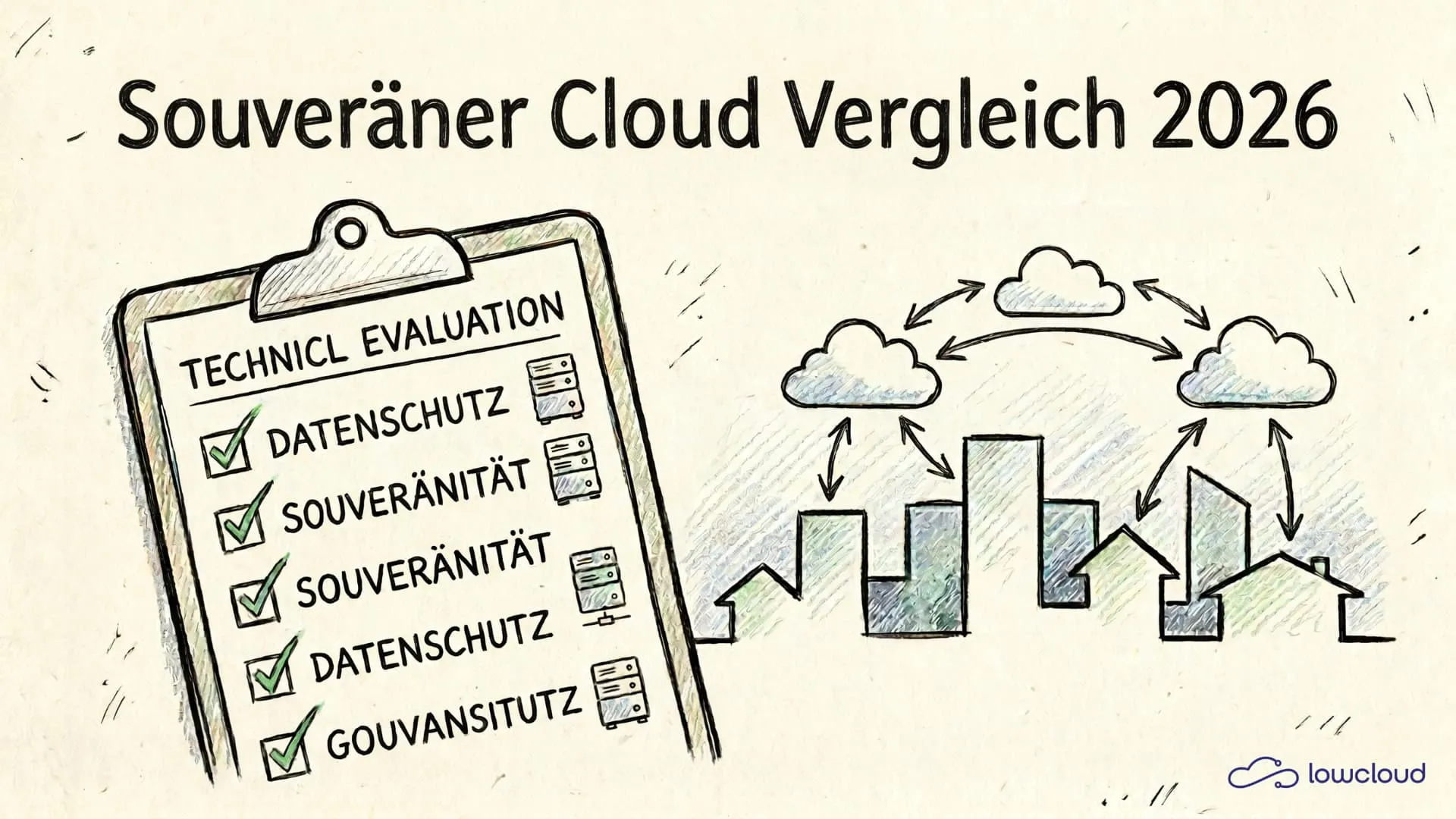
This article gives you a practical comparison framework for sovereign cloud providers in Germany, not as a glossy ranking, but as orientation and a checklist that lets you build a solid shortlist quickly, even without a large platform team.
What "Sovereign Cloud" really means in 2026
Before you compare providers, untangle the terms. In everyday use, at least four different things get sold under "sovereign", and without a clean separation you end up comparing marketing slides instead of risks and effort.
First, there is data residency: your data sits physically in Germany or the EU. That sounds simple, but in practice it often breaks down over the "by-products" of a modern stack. It's not just primary data that counts, but also backups, logs, metrics, traces, support dumps, and the temporary copies created during debug or incident situations.
Second, there is legal sovereignty. Who is the contracting party, and which corporate group stands behind it? Which laws can compel access? Since Schrems II and the debate around the CLOUD Act, this is no longer an academic question but a real part of the risk profile.
Third, there is operational sovereignty: who runs the platform day to day, who has admin access, where does support sit, and how are "break-glass" processes organized? An "EU control plane" is only worth something if the operational processes actually reflect it and don't quietly reopen global access paths in an emergency.
Fourth, you need technical sovereignty, meaning portability. Can workloads be migrated without months of rewrites? Does the provider use open standards (Kubernetes, OCI, S3-compatible), or do you end up dependent on proprietary APIs? In the end, a sovereign offering is also one that allows a realistic exit.
A quick heuristic: a cloud is sovereign when data, keys, and operations can be controlled to the point that switching platforms stays technically and organizationally feasible.
Comparison criteria: the framework you actually need
A "sovereign cloud comparison" without criteria is a waste of time. Below is a framework that holds up in practice, and one that stays manageable for vibe coders: a few hard must-haves, a fast POC, and exit questions asked early.
Quick check for vibe coders
If you only have a little time, use this quick check as a guardrail: can you go live with the provider in hours because the docs, defaults, and examples fit? Does operating it stay secure without turning into a platform-engineering project (secrets, IAM, backups, updates)? Are the data flows genuinely DE/EU, including logs and monitoring? And, crucially: is an exit realistic, do deployments and infrastructure stay close to container/Kubernetes/IaC standards, and are egress costs affordable in the exit case? If you can't answer these clearly, the rest of the comparison is often beside the point.
1) Law & ownership: who can compel what?
These questions should be asked and answered in writing. Specifically: who is the contracting party (a German/EU entity or not), and who is the parent company? Is there a US connection, directly or indirectly? Which data could be disclosed in the worst case, explicitly including metadata, and which "government request" processes exist (including transparency reports)? And finally: what does the subprocessor chain look like, especially in support, where many of the practical access paths originate?
Important: this isn't about discrediting US providers across the board. It's about making risks measurable and assessing them against your threat model.
2) Data residency: not just "Region: Frankfurt"
A "GDPR-compliant cloud" is often defined by the region. In practice, what matters is whether the complete data flows are clean. So clarify this first: where do logs, metrics, and traces end up? If observability stacks are run centrally (globally), telemetry can become the largest data-leakage surface. Next come backups: do they really sit in DE/EU, even when cross-region defaults are active, and can you control that cleanly? A third classic is support tickets: who sees dumps, configurations, or screenshots, and which tools do those artifacts end up in? And finally, key management often decides it: are there BYOK/HYOK options, external KMS, and who has access to the master keys?
3) Compliance & proof: paper isn't the same as security
Compliance isn't just "we are ISO 27001." In 2026, BSI C5 is expected in many German contexts (often as a de-facto standard), with ISO 27001 as the baseline and, depending on the industry, TISAX, PCI, or KRITIS/NIS2-adjacent requirements. What matters isn't the logo collection, though, but whether you get current audit reports (often under NDA) and whether controls are "design only" or actually operationalized, meaning logging, regular access reviews, and a functioning vulnerability-management process.
If a provider advertises "C5-ready," ask: "Which scope? Which version? Which services?"
4) Operating model: who carries which load?
For vibe coders this is often the decisive point. A cloud can be legally "clean" and still generate so much operational work that you can no longer ship.
IaaS offers maximum control but quickly leads to a mini platform team (running Kubernetes yourself, updates, SRE). Managed Kubernetes is often a good compromise, as long as upgrades, node images, ingress, and storage are truly under control, and you realistically assess whether a small team can sustain that long term. For many vibe coders, PaaS is therefore the sweet spot: fast, little ops, but only worthwhile if the platform stays close to standards (container/Kubernetes/IaC) so the exit stays realistic.
When evaluating, it helps to count fewer "features" and look more at time sinks: does the provider have secure defaults (secrets, RBAC, networking, TLS)? Are there automatic updates with transparent maintenance windows? Is there a status page and good incident communication? And as soon as more than one person is involved: is identity (SAML/OIDC) supported cleanly?
5) Technical capabilities: containers, stateful, observability
Many "EU cloud providers" are strong as long as you're stateless. As soon as databases, queues, or persistent volumes come in, the offerings diverge.
For the technical part, it pays to walk along your real stack: does the deployment run on Kubernetes/OCI containers (ideally close to upstream), can you use Helm/GitOps, and is the whole thing IaC-capable? What about stateful workloads, is there managed Postgres/MySQL/Redis or do you have to build it yourself? Does storage have clear classes (block/FS/object), snapshots, and acceptable restore times? And can you run observability (logs/metrics/traces) without data flowing into third countries? Backup/DR feels important only "later," but it's actually the thing that lets you sleep at night: RPO/RTO realistic, testable, ideally across multiple availability zones.
If the scope is "just" web apps anyway, you can evaluate more leanly. If you're building a platform team or running regulated data, base your work on the full list.
6) Lock-in & exit: the part nobody likes to plan
Sovereignty without an exit is self-deception. In practice that means: you need mature IaC (Terraform/OpenTofu support), standardized deployments (Kubernetes manifests/Helm instead of proprietary DSLs), and a data export that doesn't just exist in theory but is fast enough and isn't sabotaged by egress costs. On the contractual side, exit support, data deletion, and a traceable audit trail belong in there.
A pragmatic rule: if a provider couldn't be left within 3 to 6 months (with reasonable effort), it isn't sovereign in any practical sense, regardless of the marketing.
Provider types in Germany (and how to evaluate them)
Instead of claiming a "top 10" ranking (which would be worthless without your context), it's more useful to think in categories. In each category you'll find candidates for a shortlist.
Category A: Hyperscalers with sovereign offerings
Hyperscaler sovereign offerings usually score on feature depth and "globally proven" maturity. At the same time, sovereign variants are often legally and organizationally complex: separated controls, special operating models, a clear line between what's in scope and what isn't. That can fit when you need features that aren't available elsewhere (e.g. specialized analytics/AI stacks) and when you have the processes to manage risk and contract constructs cleanly. In practice, the most important questions are: who actually operates it, which parties have access, where do the control plane, support, and logging sit, and what is included in the sovereign scope?
Category B: German/EU cloud providers (IaaS/managed)
German/EU providers are often attractive because data residency and the legal framework are comparatively clear. Many are strong at "classic" cloud (VMs, storage, sometimes managed Kubernetes), but feature depth varies. This fits well when control and predictable compliance matter and you want less legal overhead, and when, depending on the offering, you build part of the platform yourself or can use a genuinely good managed offering. What's essential is how "managed" managed Kubernetes really is, whether storage and networking features are enough for production platforms, and how the observability stack is organized (including data flows).
Category C: Platforms/PaaS on German infrastructure
Platforms/PaaS on German infrastructure lean heavily on developer experience: fast deployments, CI/CD integration, and often preview environments. You have less ops and can ship faster. Whether that's good long term depends on how close the platform stays to standards. This category fits especially well when you want speed (one-click deployment) and German/European conditions at the same time, or when you run many apps/services and want to reduce platform work. Check three things for that: how close the model is to container/Kubernetes standards (so you can drop "down" if needed), how well stateful topics (DBs, backups, monitoring) are solved, and how auditable roles, permissions, and access are.
Checklist: how to evaluate sovereign cloud providers in 5 steps
Here's an approach that works in practice and doesn't end in "vendor slides", and that you can pull off as a solo builder in a few days.
Step 1: define the scope (data classes + threat model)
In the first step you define your scope: which data classes do you process (personal data, trade secrets, health data, financial data)? Which regulatory requirements actually matter (BSI C5, KRITIS, NIS2, or industry-specific BaFin/VAIT/KAIT)? And which threat model is realistic, more legal access, insider risk, or supply-chain topics?
Step 2: define must-have and nice-to-have criteria
When defining criteria, keep the list short enough that you can actually work through it. Typical must-haves are: data residency DE/EU including telemetry, solid audit proof (e.g. BSI C5) for the scope of the services, identity integration (SAML/OIDC), IaC-capable reproducible environments, and an exit plan that realistically reflects data export and migration.
Step 3: build a technical proof of concept (vibe-coder version)
For the POC, deploy a real project from your repository (e.g. Next.js/Remix + API) and deliberately add "real life" tests. That includes a Postgres DB plus a backup/restore test where you actually restore once. Logs and metrics should be set up so they work without data leakage. You also check how secrets/env handling is solved (rotation should at least be possible). Finally, a small kill test helps: crash the app or a worker and check whether the system comes back cleanly, so you get a feel for RTO and stability.
If the POC already requires a lot of "plumbing" to be built yourself, that's usually a warning sign for vibe coders.
Step 4: run the contract/compliance review in parallel
Run the paperwork alongside the POC: DPA (subprocessors, third-country transfer, TOMs), audit reports (if available), and a clear answer to who has operational access and how break-glass is documented and audited. The earlier you get these answers, the fewer surprises later.
Step 5: ask exit questions early
Exit questions shouldn't be settled "later" but before you commit: egress costs and limits in writing, data deletion including proof, and a clear procedure for how configurations, secrets (including rotation), logs, and backups come out. If migration support is offered, clarify the timeframe and the costs.
Common pitfalls in a sovereign cloud comparison
Common pitfalls are rarely "the provider is evil" but almost always "the default is global." "Region EU" doesn't automatically mean "no data flows": monitoring, ticketing systems, and support tools are often organized centrally. On top of that comes subprocessor sprawl, a "German" offering ends up hanging off many service providers you have to assess one by one. Another classic is logging as a data leak, because telemetry often contains IDs, payload fragments, or query parameters, and therefore personal data. And finally, exit plans are often sabotaged by egress costs: sovereignty without affordable data extraction is a trap.
Which recommendation fits which scenario?
Vibe coder / solo builder who wants to ship fast
For vibe coders, the priority is usually getting into production fast without building half a platform yourself. In practice, a PaaS/platform approach or a genuinely good managed offering often fits. What's decisive is portability (containers/K8s), clear DE/EU residency including telemetry, predictable costs, and backups/monitoring that work out of the box.
Startup/SMB with compliance requirements but a small platform team
For startups/SMBs with compliance requirements and a small platform team, the same applies: you need fast deployments with a low ops load. Either PaaS/platform or heavily managed Kubernetes, and what's decisive is portability, clear data residency, good defaults, and transparent costs.
Enterprise with a platform team and standardized processes
In the enterprise context, governance is front and center: IAM, networking, audit. Managed K8s/IaaS with a clearly defined compliance scope is often sensible; sovereign offerings from hyperscalers can fit when feature needs are high and you have the necessary processes. What's decisive is solid proof, clean operating concepts, integrations, and SLA/support.
Regulated / KRITIS-adjacent workloads
For regulated or KRITIS-adjacent workloads, you need solid proof, access control, resilience, and documented processes. Look for providers with a clear, solid C5 scope, a clean operations and support structure, and traceable data flows. Pay particular attention to auditability, break-glass, onshore ops, telemetry residency, and regular DR tests.
How lowcloud fits the picture
When the comparison makes clear that you're pursuing two goals at once, sovereignty and shipping speed, a platform problem often emerges: what you need isn't "just" infrastructure but a setup that wraps deployments, secrets, databases, and monitoring so that productivity holds up even without a large platform team.
This is exactly where lowcloud fits: as a sovereign, Germany-hosted Vercel/Railway alternative for full-stack applications. It offers one-click deployment for container workloads, including the platform building blocks that otherwise eat up a lot of time: full-stack deployment, stateful deployments (e.g. databases), and monitoring, without having to assemble everything from individual parts.
Deploy Your App: From Idea to a Live URL
Get your app live under a real URL in 30 minutes: deployment, domain, DNS and HTTPS explained step by step, with a pragmatic go-live checklist.
Claude Code vs Copilot vs Cursor: AI Coding Compared
Which AI coding tool actually makes you ship faster? Claude Code, GitHub Copilot and Cursor compared in practice – workflow, strengths, risks and team rollout.