Bring Your Own Cloud: What the Model Means and Why It

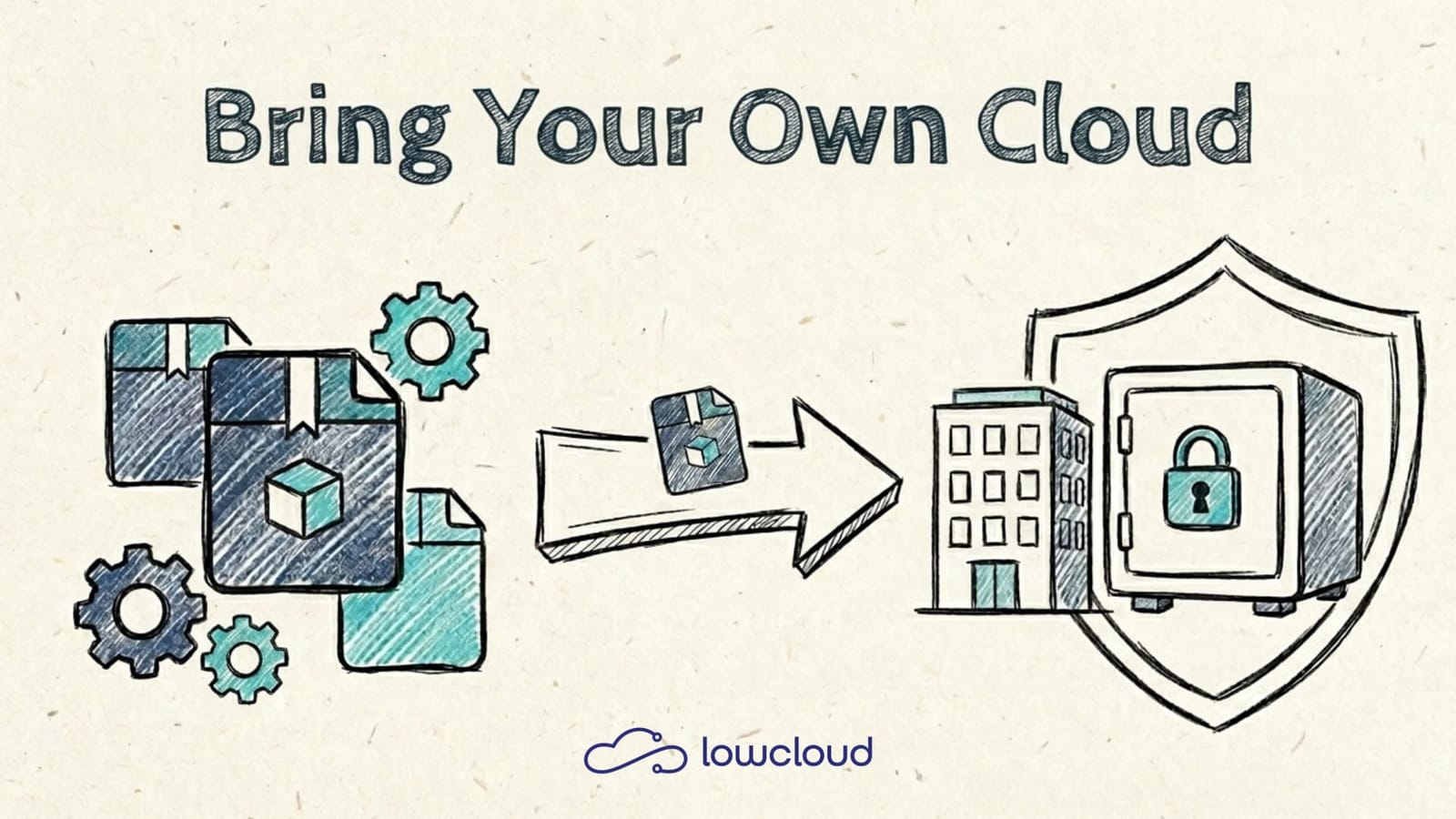
Bring Your Own Cloud is not a marketing term that explains itself. If you encounter it for the first time, you might think it is yet another cloud flavor alongside public, private, and hybrid. In reality, BYOC describes a fundamentally different software delivery model — and it solves a problem that has been waiting for a solution in regulated industries for years. Anyone running software in heavily regulated environments knows the dilemma: modern SaaS tools with comfortable operations, but no control over where the data ends up.
What Is Bring Your Own Cloud?
In the classic SaaS model, the vendor deploys its software in its own infrastructure. The customer gets access via an API or web interface — the underlying servers, databases, and network components are all on the vendor's side. Simple, scalable, but also: data control belongs to the vendor.
Bring Your Own Cloud flips this relationship. The vendor deploys its software into the customer's cloud account. Data never leaves the customer's own infrastructure. The vendor still retains responsibility for operations, updates, and support — which clearly distinguishes BYOC from classic self-hosting.
Self-hosting means: you download the software, install it on your infrastructure, and are responsible for everything yourself. BYOC means: the vendor continues to handle the operational part but deploys into your environment instead of their own.
That sounds like a minor technical detail, but in practice it makes a substantial difference — especially for companies operating under strict data protection or compliance requirements.
How Does Bring Your Own Cloud Work Technically?
BYOC is not a single protocol or standard but an architectural pattern. The concrete implementation varies by vendor, but a basic structure has emerged.
Control Plane and Data Plane: The Most Important Distinction
The core of BYOC is the separation between Control Plane and Data Plane.
The Control Plane belongs to the vendor. Configuration logic, orchestration, monitoring, and the APIs through which the customer interacts with the service all run here. It is typically hosted in the vendor's infrastructure but has only minimal, tightly defined access paths into the customer account.
The Data Plane runs in the customer's cloud account. This is where the actual workloads flow, where data is processed and stored. The vendor typically has no direct data access — they can only transmit configuration instructions via the Control Plane.
This separation is what makes BYOC possible in the first place: the vendor can develop and operate their service without ever needing direct access to customer data.
Typical Deployment Mechanisms
How does the software get into the customer account? The most common methods:
- Kubernetes Operator: The vendor provides an operator deployed into the customer's cluster. The operator communicates with the vendor's Control Plane and maintains the desired state of the deployment resources.
- Helm Charts: For simpler setups, Helm charts are delivered that the customer installs into their own cluster.
- Terraform Modules: For full infrastructure-as-code setups that provision cloud resources and Kubernetes workloads together.
After installation, the operator registers with the Control Plane, and from that point the vendor can roll out deployments, updates, and configuration changes — without needing direct access to your cluster.
Who Needs BYOC — and Why Now?
The short answer: everyone who works with sensitive data and does not want to build their own platform team.
In practice, this mainly means companies from heavily regulated industries:
- Financial services firms operating under MiFID II, DORA, or national banking regulations that often require data to be held explicitly in certain regions or under their own control.
- Healthcare providers for whom HIPAA, GDPR, or similar frameworks set clear requirements for data storage.
- Government agencies and public institutions that generally cannot process data outside their own or certified infrastructure.
- Telecommunications companies that must keep network data under their own control.
But pressure is increasing beyond these classic industries too. European enterprise customers now routinely ask about data localization during SaaS purchasing decisions. NIS2 and the EU Data Act are making the topic binding for more companies. For a practical guide to evaluating how sovereign a SaaS provider really is, including a ready-to-use checklist, see our dedicated analysis.
What makes BYOC relevant right now: Kubernetes has established itself as the de facto standard for container-based workloads. This means portable deployments are no longer a technical challenge. An operator running on GKE today runs on an on-premises cluster tomorrow — as long as both speak Kubernetes. This portability was the fundamental prerequisite for BYOC moving beyond theory.
BYOC vs. Classic SaaS vs. Self-hosted
To put the model in context, a direct comparison helps:
| Criterion | Classic SaaS | BYOC | Self-hosted |
|---|---|---|---|
| Data storage | At vendor | At customer | At customer |
| Operations & updates | Vendor | Vendor | Customer |
| Infrastructure control | Vendor | Customer | Customer |
| Compliance suitability | Limited | High | High |
| Operational effort | Minimal | Low | High |
| Time-to-value | Very fast | Fast | Slow |
BYOC combines the operational advantages of SaaS (someone else handles operations) with the data control of self-hosting. That is not a compromise — for many use cases it is the best of both worlds.
The catch: BYOC is more complex to build and operate for the vendor than classic multi-tenant SaaS. It requires a cleanly separated architecture, monitoring across customer accounts, and clear processes for updates in isolated environments. Not every vendor can or wants to deliver this. For teams evaluating whether a BYOC model genuinely protects against cloud platform lock-in, the architecture of the vendor's control plane is the decisive factor.
What Bring Your Own Cloud Means for Kubernetes Platforms
Kubernetes is no coincidence in this development. The entire BYOC architecture builds on properties that Kubernetes provides out of the box:
Portability: A Helm chart or operator runs on any conformant Kubernetes cluster — whether AWS EKS, Google GKE, Azure AKS, or an on-premises setup with k3s. Deployment code does not need to be rewritten for each cloud provider.
Declarative management: Kubernetes resources describe the desired state. An operator can manage this state remotely without needing direct cluster access — it writes manifests, the cluster executes them.
RBAC and network policies: Kubernetes provides the tools to precisely restrict an operator's access scope. The vendor operator gets exactly the permissions it needs — nothing more.
For Kubernetes-based PaaS vendors building on Kubernetes, BYOC is a logical extension of the product model. Platform logic remains centrally manageable while the execution environment becomes flexible. Customers who previously could not use cloud PaaS for regulatory reasons suddenly become reachable.
What to Look For in a BYOC Vendor
Not every BYOC offering is equal. Anyone evaluating the model should ask a few concrete questions:
Isolation: How is the Control Plane separated from the customer network? What network paths exist between the vendor and the customer account — and who controls them?
Access model: Does the vendor technically have the ability to access customer data — or is that architecturally excluded? A clean BYOC design should guarantee the latter.
Compliance certifications: What certifications does the vendor hold? SOC 2 Type II, ISO 27001, BSI C5 — depending on the industry, these are not optional extras but requirements.
Update process: Who decides when updates are rolled out? With BYOC, the customer should at least be able to control the time window.
Support model: How does the vendor debug problems if they have no direct data access? A good BYOC vendor has structured processes for this — logs are shared by the customer on request, not automatically collected.
BYOC on a Kubernetes PaaS Platform
Anyone operating or evaluating a Kubernetes-based PaaS platform will find BYOC a model that pairs well with the platform approach. Platform intelligence — scheduling, autoscaling, deployment pipelines, observability — stays centrally managed and continuously developed. The execution environment, on the other hand, can sit entirely in the customer's own account.
On lowcloud, exactly this model can be implemented: the platform handles operational complexity while workloads run in your own cloud infrastructure. Anyone who wants to understand what a BYOC setup based on Kubernetes looks like in practice will find a good starting point in the documentation and in conversations with the team.
Cloud Egress Fees Compared: AWS vs. Azure vs. GCP Pricing
AWS charges up to $0.09/GB for outbound traffic. See how egress fees compare across major providers and what to include in your true data transfer TCO.
Zero-Config Kubernetes: Why Simplicity Wins
Kubernetes configuration costs teams hours every day. How zero-configuration approaches with sensible defaults simplify deployments and boost productivity.