lowcloud vs. DevOps as a Service Providers Compared

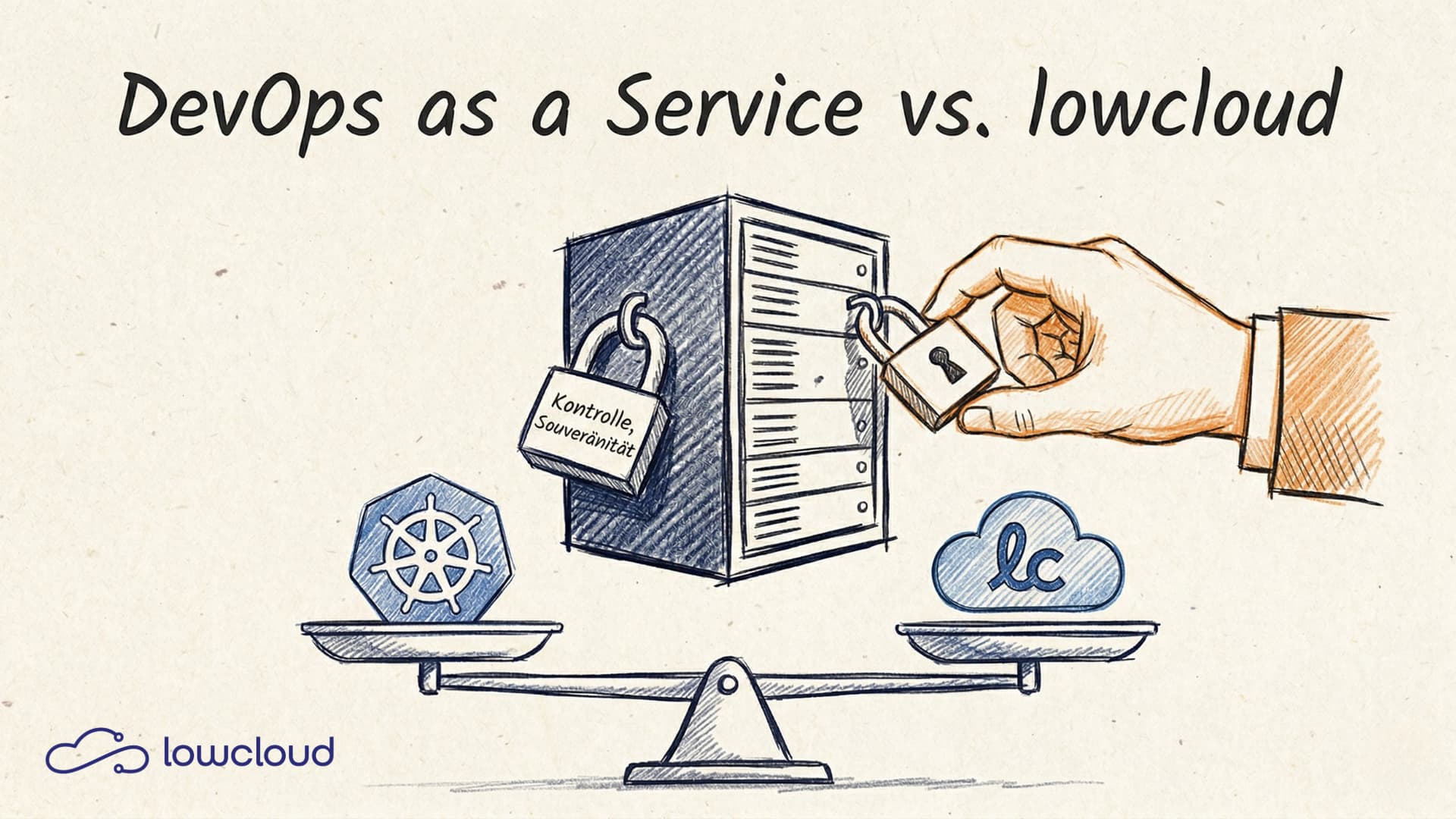
lowcloud vs. DevOps as a Service Providers: What's Really Behind the Decision
The question of whether to outsource DevOps or run it yourself sounds like a technical decision. In reality, it's a strategic one. Behind it lie questions about control over your own infrastructure, long-term costs, compliance requirements, and whether your team builds the necessary expertise or remains permanently dependent.
This article compares the model of external DevOps-as-a-Service providers with a self-operated DevOps-as-a-Service (DaaS) platform like lowcloud. No blanket recommendation — just an honest look at both approaches.
What Does DevOps as a Service Actually Mean?
The term isn't sharply defined. In practice, DevOps-as-a-Service providers offer different services, from setting up CI/CD pipelines and monitoring to complete infrastructure management including on-call support.
Typical service components:
- Building and operating CI/CD pipelines (GitHub Actions, GitLab CI, ArgoCD)
- Kubernetes cluster management on AWS, GCP, or Azure
- Monitoring, alerting, log aggregation
- Incident response and 24/7 on-call support
- Security hardening and compliance documentation
It sounds appealing, especially for teams that lack DevOps expertise or need to deliver quickly. The service provider handles the complexity while the internal team focuses on application development.
So much for the theory.
What Is lowcloud and How Does It Differ?
lowcloud is a Kubernetes DaaS platform built on GitOps principles. Instead of hiring a service provider, your team gets a platform that abstracts Kubernetes complexity without sacrificing control or transparency.
The difference from a classic managed service or DevOps provider: the infrastructure runs on resources under your own control or on sovereign European infrastructure. There's no black box, no external hands in production systems, no dependency on an outside team for every deployment.
This model suits teams that want to build platform engineering internally without developing everything from scratch.
Cost Comparison
At first glance, external DevOps providers seem expensive. On closer inspection, the picture is more complex.
Typical costs with DevOps-as-a-Service providers:
An experienced DevOps engineer as an external contractor costs between 800 and 1,400 euros per day in Germany. For a complete retainer model with on-call coverage, ongoing operations, and regular adjustments, monthly costs quickly reach 8,000 to 20,000 euros — depending on scope.
Then there are hidden costs: onboarding time, communication overhead, and dependencies whenever any change needs to go through the provider.
Typical costs with a DaaS platform like lowcloud:
A platform subscription has predictable monthly fees. The initial effort is higher — the team needs to understand and set up the platform. After that, operational overhead drops significantly because routine tasks are handled by the platform.
The crucial difference: with a DaaS platform, the company invests in its own expertise. With a service provider, it buys time that disappears as soon as the contract ends.
Control, Transparency, and Data Sovereignty
This is the point where many teams only feel the difference when it's too late.
Vendor Lock-in and Switching Costs
External DevOps providers build infrastructure according to their own standards. That's efficient as long as the collaboration works. When the contract ends or the provider changes, the internal team faces a setup that nobody fully understands.
Undocumented configurations, proprietary scripts, secrets in external vaults — switching costs in many outsourcing models are systematically high. That's not an oversight; it's a business model.
With a self-operated DaaS platform, everything stays internal: configurations in Git, complete documentation, no knowledge that only exists in the heads of external staff.
Compliance Requirements and GDPR
For companies with stricter requirements — such as those in healthcare, financial services, or public administration — the question of who has access to production systems is not a formality.
Many DevOps-as-a-Service providers work with subcontractors, have teams in different countries, and require extensive access to infrastructure to do their job. This is often difficult to reconcile with GDPR requirements or industry-specific compliance mandates.
lowcloud runs on infrastructure in German or European data centers, without external third parties needing access to production systems.
lowcloud: When Is the Platform the Better Path?
lowcloud is suited for teams that view infrastructure as a strategic asset — not as a necessary evil they'd rather delegate.
lowcloud makes sense when:
- The team wants to manage Kubernetes workloads themselves without building everything from scratch
- Data sovereignty and control over production systems are non-negotiable
- Building long-term internal expertise is a priority
- Predictable infrastructure costs matter more than maximum outsourcing flexibility
- Compliance requirements restrict access by external third parties
The platform model pays off especially when the application landscape grows and infrastructure needs to scale with it — without every change having to be coordinated through an external provider.
Decision Guide: The Key Criteria
| Criterion | DevOps as a Service | lowcloud (DaaS Platform) |
|---|---|---|
| Infrastructure control | Low (provider decides) | High (own team) |
| Initial effort | Low | Low |
| Long-term costs | High, hard to predict | Low, predictable |
| Internal knowledge building | Minimal | Yes, systematic |
| Vendor lock-in | High | Low |
| Data sovereignty | Limited | Full |
| Compliance (GDPR, BSI) | Complex, often problematic | Easy to implement |
| Scalability | Depends on provider | Self-managed |
| Best suited for | Small teams without infra focus | (Small) teams with sovereignty focus |
If you want to run a Kubernetes environment without being permanently dependent on an external provider, lowcloud offers a platform that reduces operational overhead without giving up control. The model isn't right for everyone, but for teams that see infrastructure as a core competency, it's the more direct path.
If you want to know whether lowcloud fits your setup, check out the platform documentation or talk to us directly. No sales funnel, no mandatory demo — just an honest conversation about whether the model works for you.
Managed Services ROI: Why Self-Hosting Costs More Than You Think
A full TCO comparison of self-hosted vs. managed Kubernetes. Why running your own cluster often costs 60% more than expected – with a concrete cost model.
Kubernetes vs. Docker Swarm: Key Differences and Why K8s Won
Kubernetes and Docker Swarm compared: architecture, scaling, networking, and storage. Why Kubernetes became the standard and when Swarm still makes sense.