DevOps vs. DevOps as a Service – Which One Fits Your Team?

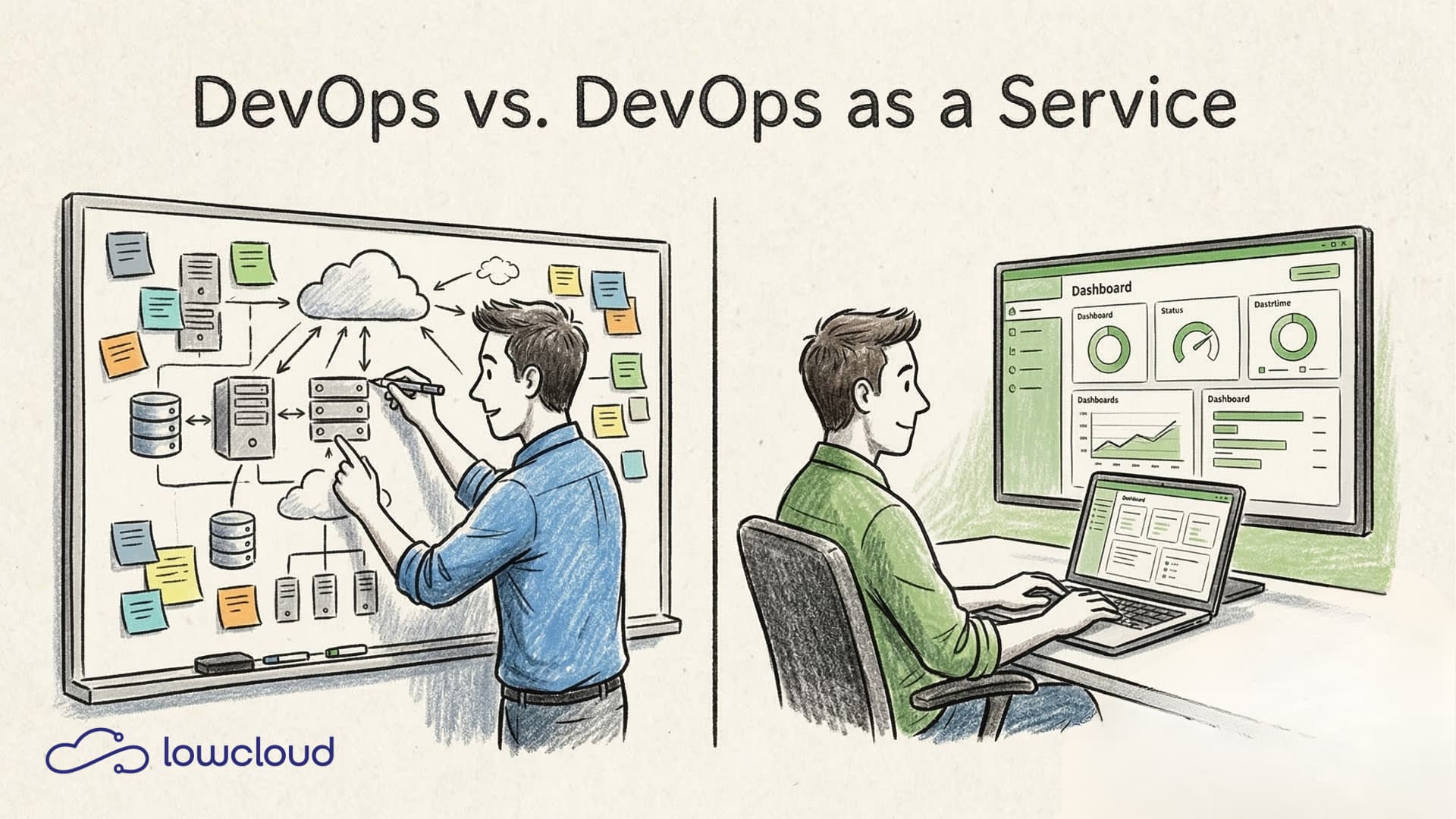
DevOps vs. DevOps as a Service – What's the Difference and Which One Fits Your Team?
DevOps is more than a buzzword – it's a way of working that brings development and operations together. But there's a significant difference between building your own DevOps practice and using DevOps as a Service. This article explains what's behind both models, how they differ, and when each one makes sense for your team.
What Is DevOps?
DevOps is a combination of cultural principles, practices, and tools aimed at improving collaboration between development (Dev) and operations (Ops). The goal: shorter development cycles, more frequent releases, and higher software quality.
In practice, that means:
- CI/CD pipelines that automatically build, test, and deploy code
- Infrastructure as Code (IaC) to manage infrastructure in a reproducible, version-controlled way
- Monitoring and observability to quickly detect and resolve issues
- Collaboration where developers take ownership of running their own services — an approach explored in depth in our article on collaborative DevOps teams
Building such a practice isn't a one-time project. It's a continuous process that requires knowledge, time, and dedicated resources. For small teams or companies without specialized ops staff, this quickly becomes a challenge.
What Is DevOps as a Service?
DevOps as a Service refers to an operating model where DevOps capabilities – tooling, pipelines, infrastructure, and operational processes – are provided by an external vendor or platform.
Instead of building and maintaining your own toolchain internally (GitHub Actions, ArgoCD, Prometheus, Grafana, Vault, ...), the development team uses a ready-made, managed environment. The provider handles operations, updates, security patches, and often scaling as well.
This isn't outsourcing in the traditional sense. The development team retains control over its applications and pipelines. What gets offloaded is the complexity underneath: the infrastructure everything runs on.
Head-to-Head: DevOps vs. DevOps as a Service
| Criterion | DevOps (Build Your Own) | DevOps as a Service |
|---|---|---|
| Control | Full | Limited (depends on provider) |
| Initial effort | High | Low |
| Ongoing operations | Your team | The provider |
| Cost | Personnel-intensive | Service fee, more predictable |
| Scalability | Self-managed | Often automated |
| Vendor lock-in | None | Possible |
| Compliance | Your responsibility | Often pre-configured by provider |
| Onboarding speed | Weeks to months | Days to weeks |
When Does Building Your Own Make Sense?
If you have a large, specialized team that's deeply experienced with Kubernetes, CI/CD, and infrastructure topics, building your own setup makes sense. You get maximum flexibility: you choose every component yourself, integrate it to your requirements, and stay independent from any provider.
This pays off especially when:
- Your infrastructure requirements are very specific or unusual
- You need full control over the toolstack for regulatory reasons
- You want to strategically build internal know-how
- You already have a strong ops team that can fill the gaps
The cost is real, though: someone has to build the pipelines, upgrade Kubernetes clusters, maintain monitoring dashboards, and get paged at night when something goes down. That ties up developer time that could otherwise go into the product -- a cost differential our managed services ROI analysis quantifies at roughly 60%.
When Does DevOps as a Service Make More Sense?
For most teams – especially startups, scale-ups, and SMBs facing common DevOps challenges – DevOps as a Service is the more pragmatic choice. Not because building your own is inherently worse, but because the cost-benefit ratio in many situations clearly favors a platform solution.
Typical scenarios:
- The team is small and has no dedicated ops staff
- Time-to-market is critical and you can't afford weeks of infrastructure configuration
- The application landscape is container-based and maps well onto a PaaS platform
- Compliance requirements (e.g., GDPR, industry-specific standards) should come pre-configured by the provider
The key question isn't "control or convenience" – it's: which complexity do you want to carry yourself?
What DevOps as a Service Means in Practice
A common misconception: DevOps as a Service doesn't mean you don't need to understand DevOps. It means you don't have to build and manage the operational layer yourself.
What a good DevOps-as-a-Service offering typically handles:
- Provisioning and operating Kubernetes clusters
- Pre-configured CI/CD pipelines you can use and customize
- Centralized logging, monitoring, and alerting
- Automated security updates and patch management
- Network and storage configuration
What stays with the development team:
- Application code and business logic
- Deployment configuration (e.g., Helm charts, Kubernetes manifests)
- Decisions about scaling behavior and resource limits
- Testing strategy and quality assurance
That's a sensible division of labor. The provider takes care of operational stability; you take care of your product.
Kubernetes and DevOps as a Service – A Natural Fit
Kubernetes has established itself as the standard for container-based workloads. At the same time, Kubernetes is complex: cluster management, networking, storage, RBAC, ingress controllers, secrets management – each of these topics is a discipline in its own right.
This is exactly where Kubernetes DaaS platforms bridge the gap. They provide Kubernetes as a production-ready environment, complemented by DevOps tooling, so development teams can get started right away.
Platforms like lowcloud take this a step further: they combine the DevOps-as-a-Service model with sovereign infrastructure – meaning operations in German or European data centers under European law. This is particularly relevant for companies that don't want to treat GDPR compliance or specific data protection requirements as an afterthought.
DevOps as a Service vs. DevOps-as-a-Service Platform – What's the Difference?
DevOps as a Service primarily describes an operating and responsibility model: an external provider takes over (fully or partially) the setup and operation of your DevOps capabilities – tooling, platform operations, updates, security patches, monitoring setup, incident handling, etc. The key point: it's about people and processes (who does what, with which SLAs), not necessarily a specific product.
A DevOps-as-a-Service platform, on the other hand, is the technical implementation of this model: a platform bundles the typical building blocks (e.g., Kubernetes, CI/CD, registry, secrets, observability, policies) and makes them available as a standardized, repeatable self-service experience. It reduces complexity through automation, guardrails, and opinionated defaults.
In practice, this means:
- DevOps as a Service can also be "traditional": a service provider runs your toolchain and infrastructure, with a lot happening through tickets and manual work.
- A DevOps-as-a-Service platform is more productized: fewer tickets, more self-service – with clearly defined responsibilities.
Where Does lowcloud Fit In?
lowcloud isn't simply "a service provider that does DevOps" – it's a DevOps-as-a-Service platform built on Kubernetes that delivers DevOps capabilities as a product, including the automation and standards that would otherwise consume significant internal engineering effort.
Importantly, lowcloud combines this platform approach with a sovereign setup. By focusing on operations in German/European environments (and depending on the setup, also in your own infrastructure/provider account), you get the benefits of DevOps as a Service without giving up control entirely.
Conclusion
DevOps and DevOps as a Service aren't competing concepts. They're two different paths to the same goal: delivering software faster, more reliably, and more sustainably. As organizations scale, the distinction between DevOps and Platform Engineering becomes equally important, and platform engineering as a discipline deserves a closer look.
Building your own makes sense if you have the resources, knowledge, and strategic motivation to control your DevOps infrastructure yourself. DevOps as a Service is the better choice if you want to ship fast without overwhelming your team with infrastructure concerns.
For many teams, the decision is less about conviction and more about pragmatism. The time a small team spends on Kubernetes cluster management is time taken away from other priorities. A platform that absorbs that complexity isn't a compromise – it's a deliberate choice to focus.
If you want to learn more about how a Kubernetes DaaS platform can take the load off your team, take a look at what lowcloud offers. For a direct comparison of lowcloud vs. external DevOps providers, see our detailed breakdown. No sales pitch – just an honest answer to which problems we solve, and which ones we don't.
Sovereign Cloud: Can SaaS Really Maintain Control Over Your Data?
SaaS services are indispensable in daily work, yet pressure is growing to prove control over data. This article shows how to assess how sovereign a SaaS provider really is.
Docker Fundamentals - Understanding Container Virtualization
Start with Docker - This guide explains to technical readers how containers work, how they differ from VMs, and why they are the modern standard.