The 7 Biggest DevOps Problems in SMBs – And How to Fix Them

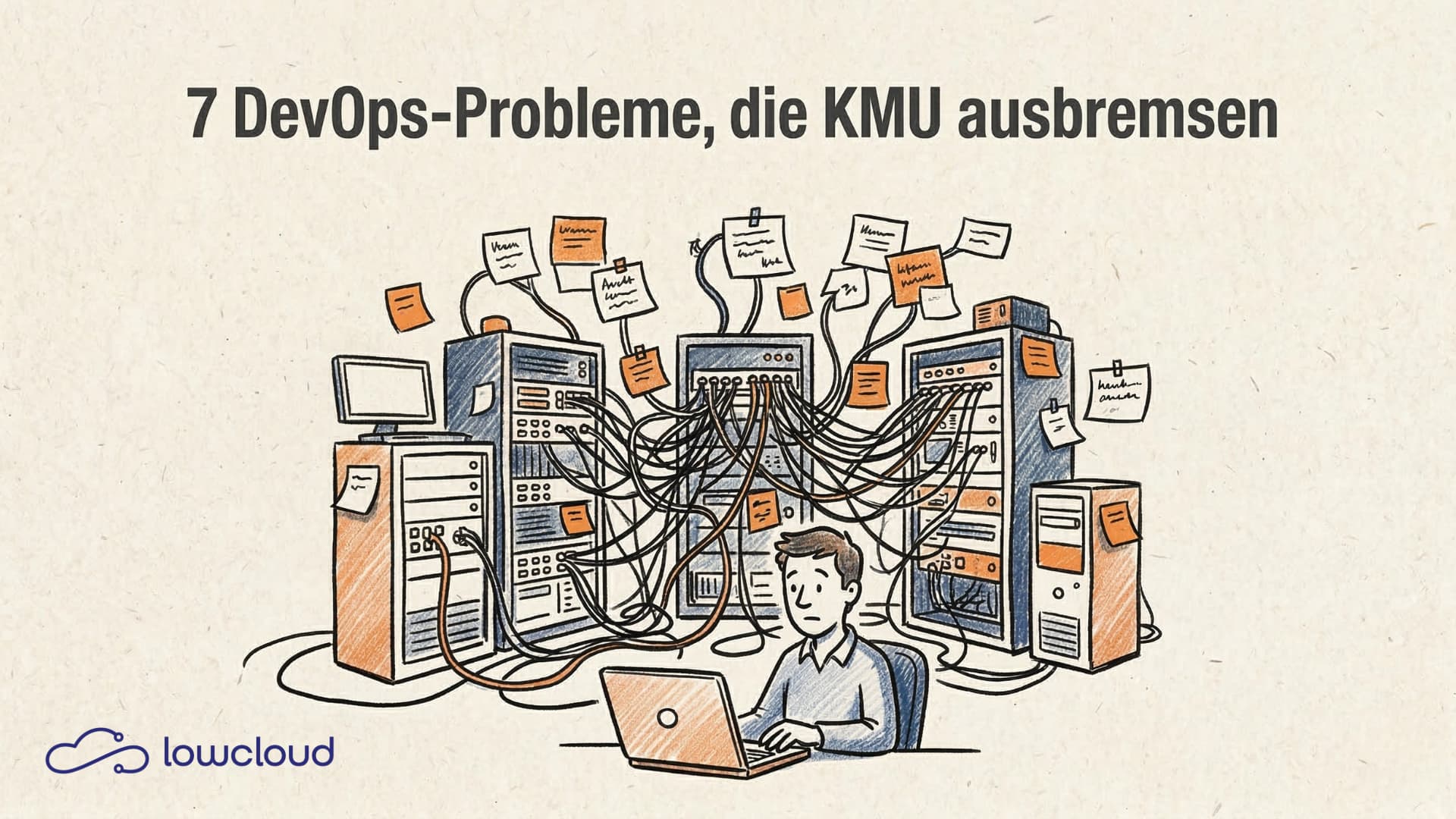
The 7 Biggest DevOps Problems in SMBs and How to Fix Them
DevOps promises faster releases, more stable systems, and less manual work. In practice, things often look different for small and medium-sized businesses: resources are tight, the team is small, and the infrastructure has grown organically over the years. If you know these seven problems, you can address them head-on — instead of stumbling over the same issues again and again.
Why DevOps in SMBs Is Different from Enterprise
When large companies adopt DevOps, they typically have a dedicated platform team, their own tooling strategy, and a budget that allows for experimentation. SMBs operate under different conditions: one developer manages the infrastructure on the side, deployments follow a manual step described in a wiki article that only one person truly understands.
That's not failure — it's a structural reality. The methods that work in enterprise settings can't simply be scaled down. Ignoring this leads to buying tools nobody uses and introducing processes that create more overhead than they eliminate.
The good news: most of the problems that cause DevOps to fail in SMBs are well-known and solvable — if you call them by name.
Problem 1 – No Dedicated DevOps Role
Many SMBs don't have a DevOps engineer. Instead, there's a developer who "also handles infrastructure" — on top of their actual responsibilities. It sounds pragmatic, but it reliably leads to problems — a pattern we analyze in depth in our article on missing DevOps roles in SMBs. For a broader look at what full-stack responsibility actually demands today, and why the title has become a semantic minefield, see our dedicated post.
When that person is sick, deployments stop. When they leave the company, implicit knowledge walks out the door. And as long as the infrastructure "somehow works," nobody will invest the time to set it up properly.
What helps: Clarity, not headcount. Even without a dedicated position, you can define who is responsible for CI/CD, monitoring, and deployments — and give that person dedicated time for it, not tasks on top. A platform that abstracts much of this work can make the difference between "works somehow" and "works reliably."
Problem 2 – Manual Deployments as the Permanent State
"We know we need CI/CD. We just never get around to it." This sentence comes up in many SMB conversations about DevOps.
The problem isn't a lack of knowledge — it's a lack of entry point. A full CI/CD pipeline sounds like a project that takes weeks. So manual deployment stays — with all its consequences: copy-paste errors, long deployment windows, no rollback strategy.
The risks of manual deployments are well documented: the less frequently you deploy, the larger the batches become, and the higher the risk per release. Small, frequent deployments are more stable than large, infrequent ones. That's not an opinion — it's one of the core findings from "Accelerate."
What helps: Not the perfect pipeline, but a working one. A simple trigger that automatically builds and tests on every push to the main branch is better than nothing. Our guide to software deployment for SMBs walks through the steps. You can expand from there.
Problem 3 – Monitoring? When Users Complain, We'll Know
Missing observability is the silent problem. Systems run — until they don't. And then the team finds out through a user, a Slack message, or a phone call.
This isn't a technical problem — it's a prioritization problem. Monitoring doesn't feel productive while everything is running. It only pays off when things break — and by then it's too late to set it up.
Good monitoring in an SMB context doesn't have to be complex: an application performance monitoring tool, an alert on elevated error rates, a dashboard with the most important metrics. Our guide to Kubernetes monitoring with logs and metrics covers what a practical setup looks like. If you don't know whether your system is healthy right now, you can't do DevOps — you can only react.
What helps: Start with three metrics: error rate, latency, availability. Set up alerts for them. Expand from there. Working on a platform that provides observability out of the box saves significant time.
Problem 4 – "Works on My Machine" – Inconsistent Environments
The classic. A bug appears in production but can't be reproduced locally. This costs hours, sometimes days.
The cause is usually a drift between the development environment and production: different configurations, different dependencies, different OS versions. In teams without clear agreements on development environments, this drift grows with every person who joins.
Containers solve a large part of the problem — when used consistently. Infrastructure as Code ensures that staging and production are truly identical. That's not gold-plating — it's a prerequisite for reliable deployments.
What helps: Containerize the application, use IaC for infrastructure, and establish a clear dev environment setup that can onboard new team members in minutes.
Problem 5 – Security Gaps in the Pipeline
DevSecOps is often not even a term in SMBs, let alone a practice. Yet the typical security issues in DevOps pipelines are well known: secrets in Git repositories, missing vulnerability scans for container images, no RBAC strategy for the Kubernetes cluster.
These are not theoretical risks. Exposed secrets in public repositories are found and exploited within minutes. An unscanned container image with known CVEs is an open gateway.
SMBs often underestimate their own risk. "We're too small to be interesting" — that's simply not true. Automated attacks scan the entire internet, not just well-known targets.
What helps: Secrets management from the start (no secret belongs in an environment variable in the repository), automatic image scans in the CI pipeline, minimal RBAC configuration in the cluster. This can be introduced step by step.
Problem 6 – Tool Chaos and Lack of Standardization
With every new project comes a new tool: a different CI system, a different monitoring solution, a different deployment tool. After two years, there are five different setups that nobody fully understands.
Tool sprawl is a real productivity problem. Every tool has its own configuration syntax, its own quirks, its own failure scenarios. If you have to operate all of them, you can't be truly good at any of them.
Standardization feels restrictive but creates reliability. When the team uses the same pipeline template, the same monitoring setup, and the same deployment pattern for every new service, the cognitive overhead drops significantly.
What helps: Fewer tools, used well. One CI platform for everything is better than three different ones. One observability solution with standard configurations beats ad-hoc setups per project.
Problem 7 – Knowledge Silos and Missing Documentation
The bus factor is the most honest measure of team resilience: how many people would have to leave the company before a critical system becomes unmaintainable? In many SMBs, the answer is: one.
The knowledge of how deployments work, how the cluster is built, which configuration lives where — it's all in the heads of the people who built the system. Documentation is created after the fact, if at all.
That's not a character flaw — it's a symptom of time pressure. Yet it's one of the most expensive problems in operations: slow onboarding, dependency on individuals, costly outages when the wrong person is on vacation.
What helps: Infrastructure that documents itself — through IaC, through readable pipeline configurations, through runbooks that are kept short and up to date. For a deeper look at why documentation fails and how to fix it, see our guide on reducing bus factor through documentation. Not an encyclopedia, but a reliable foundation.
The Common Denominator: Missing Platform Abstraction
When you lay these seven problems side by side, a pattern emerges: it's not that SMB teams are worse than enterprise teams. It's that they have to solve the same tasks with a fraction of the capacity.
The structural answer is platform abstraction: a layer that automates and standardizes routine tasks — deployment, monitoring, secrets management, scaling — to a degree that lets the development team focus on the product, not the infrastructure. This concept is formalized as a Platform Engineering approach, where a dedicated team builds an Internal Developer Platform for self-service access.
That's exactly the approach behind lowcloud: a DevOps-as-a-Service platform that provides this abstraction for SMBs — without enterprise complexity, without lock-in to proprietary tools. If you don't want to build a platform team but simply want to deploy, this is a solid foundation.
Conclusion and Next Steps
These seven problems won't be solved overnight. But they can be prioritized.
If you want to start today, ask yourself one question: which of these problems is currently costing us the most time or creating the biggest risk? That's your entry point.
For most teams, it's problem 2 or 3 — missing automation or missing monitoring. Both can be tackled with manageable effort, provided the infrastructure supports it — and as our IT cost reduction analysis shows, the ROI is often faster than expected.
DevOps in SMBs isn't a state you reach at some point. It's a continuous process that favors small, reliable improvements over big leaps. The upside: you don't have to solve all seven problems at once.
Docker Fundamentals - Understanding Container Virtualization
Start with Docker - This guide explains to technical readers how containers work, how they differ from VMs, and why they are the modern standard.
PostgreSQL Helm Chart: How to Deploy Postgres on Kubernetes
Learn how to deploy PostgreSQL with Helm on Kubernetes, why Bitnami charts have become problematic, and what alternatives are available.