Knowledge Documentation in DevOps Teams: How to Actually Reduce Your Bus Factor

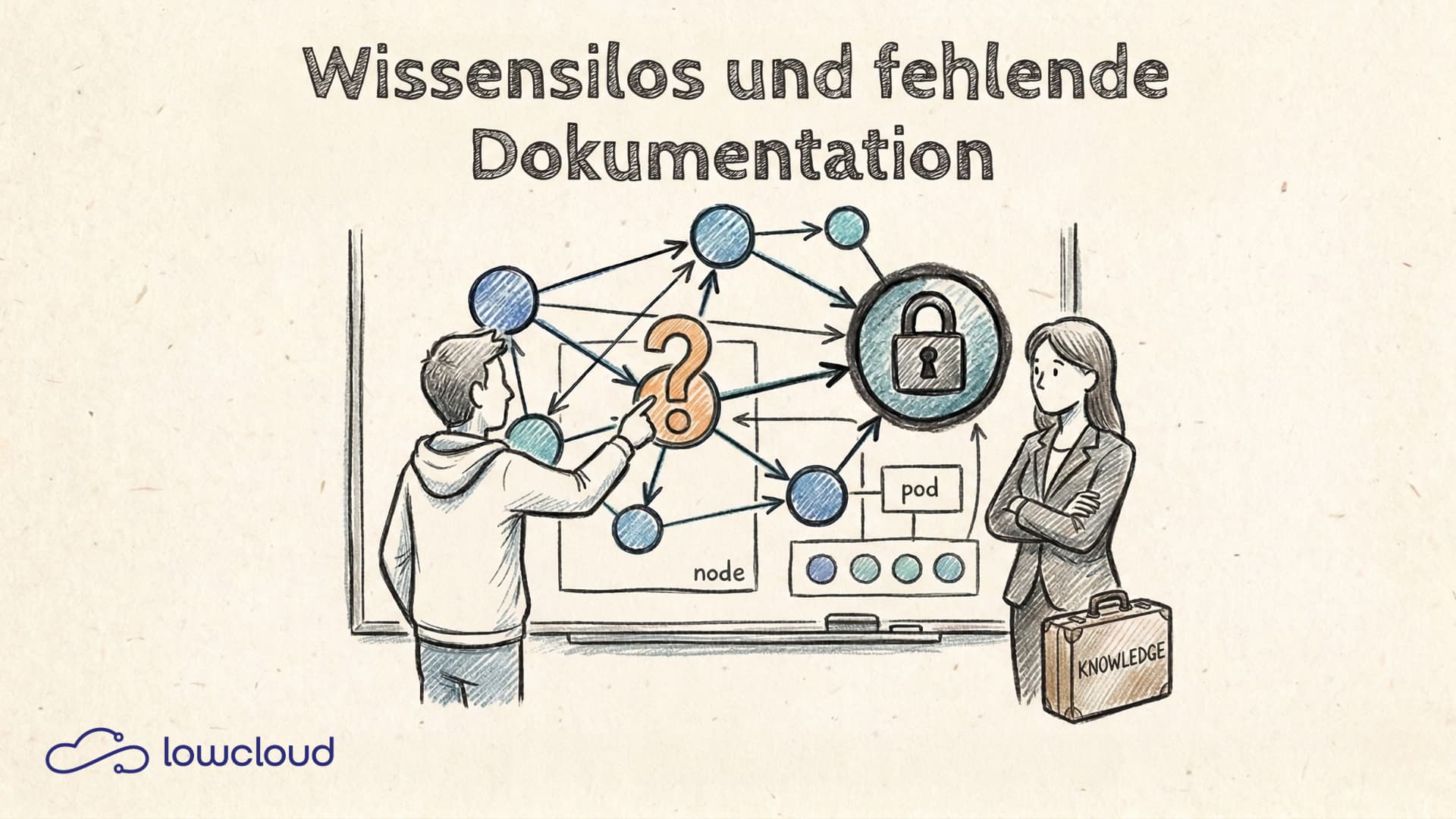
The bus factor is uncomfortable to measure because the result is rarely flattering. When one person leaves the company or is simply on vacation and a critical system becomes unmaintainable as a result, that's not bad luck. It's a structural problem. This article shows why knowledge documentation in DevOps teams fails so often and which approaches actually make a difference.
What the Bus Factor Really Measures
The term sounds morbid, but it's precise: How many people would have to be unavailable at the same time for your team to lose the ability to operate a critical system? A number greater than two is considered solid. In many SMBs, the answer is one — one of the most common DevOps problems in SMBs.
This isn't a criticism of the individuals involved — it's a symptom of how infrastructure evolves in small teams. Someone builds the system, learns along the way, makes decisions. Those decisions rarely end up in a document. They end up in someone's head.
Why this is dangerous: A Kubernetes cluster has many moving parts. Which namespace belongs to which service? Why does the ingress controller run on that specific configuration? Why was Helm chosen over Kustomize back then? If nobody knows the answers except one person, you have a knowledge monopoly — and knowledge monopolies are expensive risks.
Why Documentation Always Fails in Small Teams
Documentation in small teams rarely fails due to a lack of willingness. It fails because it doesn't fit the reality: little time, fast pace, constantly shifting priorities. And that's exactly why two patterns almost always emerge.
Problem 1: Documentation Is Treated as an Afterthought (and Always Loses)
In small teams, the day is packed with "real" work: finishing features, solving customer issues, keeping releases stable. Documentation automatically lands at the bottom of the priority chain — as a sticky note on a ticket or a "we'll do it later."
This sounds harmless but has several systematic effects:
- Motivation disappears once the problem is solved: As soon as an incident is resolved or a feature is shipped, documentation feels like bureaucracy. The pain is gone, so there's no pressure to write it down properly.
- Context vanishes extremely fast: Why was a decision made? Which alternative was discarded? Which assumption was important at the time? After a few days, the knowledge is already "approximate" — after a few weeks, it's being reconstructed rather than documented.
- The next task pushes in: Small teams rarely work with generous time buffers. When the next ticket is already waiting, documentation feels like a luxury. And luxury never wins against an urgent to-do.
- Quality decreases the later you write: People who document after the fact tend to write vaguely ("we did X this way") instead of concretely ("we did X for reason Y, with risk Z, and rollback is A"). This vague documentation barely helps in an emergency.
The result is predictable: documentation either never gets created, or it becomes a "snapshot" of yesterday. But infrastructure isn't a snapshot — it changes. And when documentation isn't part of the normal workflow (e.g., review checklists, PR templates, definition of done, runbook updates on alerts), it becomes legacy debt.
Problem 2: The Wiki Grows Large and Becomes Untrustworthy (Information Entropy)
The second classic is the "wiki paradox": you try to solve the documentation problem by writing more documentation. This creates volume, but not automatically value.
Over time, the following happens:
- Wikis grow faster than they can be maintained: Every new component creates new pages, every change creates new discrepancies. Maintenance is an ongoing task, but in daily practice it's treated as a one-time effort.
- Nobody knows what's still accurate: Once a team has experienced 1–2 times that a wiki page was outdated or wrong, trust drops. And without trust, the wiki stops being consulted.
- Search replaces structure — and fails: Instead of clear "golden path" documents, there are many individual pages. People search by keywords, get five results, and have to guess which one is valid.
- Documentation becomes "archaeology": New team members read through historical entries without knowing what's relevant today. This costs time, creates uncertainty, and ultimately leads back to the same solution: asking someone.
The effect is paradoxical here too: there's "a lot" of documentation, but it barely reduces dependency on individuals because the team doesn't use it as a reliable source.
Why These Two Problems Reinforce Each Other
Both patterns are connected:
- Because documentation happens as an afterthought, it becomes irregular and fragmented.
- Because it's fragmented, the wiki grows chaotically.
- Because the wiki is chaotic, trust drops.
- Because trust drops, people document even less ("nobody reads it anyway").
And once that happens, knowledge gets distributed verbally again: via Slack messages, in calls, on the fly. This is efficient in the short term — but it rebuilds the bus factor.
What This Means in Practice
If you're reading this chapter and thinking "yes, that's exactly how it is for us," that's not individual failure. It's a signal that your documentation approach doesn't fit your team size and working mode.
The solution is therefore almost never: "write more." The solution is: write less, but more integrated and reliable — and shift as much as possible into self-documenting artifacts (IaC in Git, traceable deployments, clear defaults, short runbooks), so that documentation doesn't have to work against reality, but with it.
Infrastructure as Code as Living Documentation
The most effective step against knowledge silos isn't writing more documentation. It's building systems that document themselves.
Infrastructure as Code is exactly that. When your cluster setup lives in Git, the current state of the system is traceable at any time. Anyone who wants to know how a deployment is configured looks at the repository — not into a colleague's head.
This requires that IaC is actually the single source of truth. If configurations are manually overridden and the repository no longer reflects the real state, you lose the advantage immediately. Process discipline matters more here than tooling.
Comparing Terraform, Helm, and Kustomize
Three approaches have established themselves for Kubernetes environments:
- Helm offers templates with variables. The code is readable as long as the values files are maintained. A solid standard for recurring deployments.
- Kustomize works with overlays on base manifests. Less abstraction, but closer to native Kubernetes YAML. Good for teams that prefer working directly with manifests.
- Terraform with the Kubernetes provider works well when infrastructure and applications should be managed from a single source. The learning curve is steeper, but consistency across multiple environments is hard to beat.
Which tool fits your team better depends less on features and more on how you work. What matters is: whatever you choose, it must live in Git, and the actual state must be reflected in it.
# Example: Helm deployment with explicit values for traceability
helm upgrade --install my-service ./chart \
  --values ./environments/production/values.yaml \
  --namespace production \
  --atomic
Why IaC Isn't Always the Best Answer for SMBs
Infrastructure as Code is a strong principle, but it has an often underestimated prerequisite: there must be someone who permanently "owns" the infrastructure as code.
Especially in SMBs, one (or several) of these problems frequently occurs:
- High entry barrier and tool overhead: Terraform/Helm/Kustomize, state handling, module structure, secrets, provider versions, testing, policy. This is valuable but not "free." For small teams, IaC can quickly become a second product.
- Maintenance is not optional: IaC only reduces drift if it's consistently the only way to make changes. In practice, hotfixes, manual interventions, provider updates, and breaking changes occur — creating documentation and operational work again.
- The bus factor just shifts: Without clear standards and ownership, knowledge no longer lives "in someone's head" but in a set of scripts/modules that only one person truly understands.
- More degrees of freedom = more variance: IaC allows many ways to be "correct." In small teams, this often leads to individual handwriting rather than a stable standard — and thus to exactly the onboarding problem you were trying to solve.
This doesn't mean "IaC is bad." It just means: in SMBs, the question isn't "can we do IaC?" but "can we operate IaC cleanly long-term — and is that the best use of our limited time?"
Why DevOps as a Service Can Help Here
A DevOps-as-a-Service platform shifts the focus from "we build and maintain our own IaC framework" to "we use standards that are already productized."
The practical benefit for SMBs:
- Standardized deployments and defaults: Less decision-making and maintenance overhead because central baseline patterns are already predefined.
- Less to document: When ingress, observability, security basics, and deployment mechanics are standardized through the platform, teams primarily need to document application-specific knowledge.
- Ownership stays with the team — without the ops overhead: Teams can work self-service without having to model every detail of Kubernetes/IaC themselves.
In this model, IaC as a principle is preserved (versioning, traceability, repeatability), but the amount of self-maintained "platform code" decreases. For many SMBs, that's exactly the difference between "we intend to document" and "our infrastructure is actually understandable and repeatable."
Runbooks: Small, Current, Usable
A runbook isn't documentation in the traditional sense. It's an operational guide for a specific scenario: What to do when a pod crashes? How is a rollback performed? What are the first steps during a database outage?
Good runbooks are short. If a runbook is longer than one page, it's no longer a runbook — it's a manual that nobody reads in an emergency. The goal is: someone who doesn't know the system from the ground up can narrow down the problem in a few minutes.
What a useful runbook contains:
- Symptom: How do I recognize the problem?
- Causes: What are typical triggers?
- Immediate actions: What can I do right now to limit the damage?
- Escalation: Who do I contact if this doesn't help?
Runbooks must live where they can be found in an emergency — not in a nested wiki, but in a known, quickly accessible location. And they must stay current: a runbook pointing to a configuration from two years ago is worse than having none at all.
How a DaaS Platform Reduces Documentation Overhead
An often underestimated lever is the platform layer itself. The more complexity is hidden behind an abstraction layer, the less there is to document.
On a DevOps-as-a-Service platform like lowcloud, developers deploy applications through standardized interfaces. The question "How is our ingress configured?" no longer arises in the same way — that's the platform's job. What the team needs to document shrinks to the application-specific parts.
This doesn't just reduce documentation overhead. It also increases quality: when the team focuses on a smaller, more clearly defined area, it's more realistic that documentation stays current.
Beyond that, managed platforms often come with built-in observability, audit logs, and traceable deployment histories. This doesn't replace documentation, but it provides context that would otherwise be lost.
Knowledge Transfer During Personnel Changes
Offboarding is the moment when missing documentation becomes most expensive. A person leaves the company, and with them go decision backgrounds, undocumented configurations, and informal knowledge about system relationships.
No onboarding process in the world can compensate for this if the fundamentals are missing. What helps is a structured handover — not as a PDF document shortly before the last working day, but as a continuous process.
Pair sessions where knowledge is actively transferred are more effective than written documentation alone. Combined with a well-maintained IaC foundation and current runbooks, the bus factor drops noticeably — even without someone having to explain the entire system from scratch.
A simple test: Could a new team member, without asking questions, deploy an existing service, narrow down an error, and trace a configuration change? If not, you have a documentation problem — regardless of how many wiki pages exist.
Conclusion: Documentation That Lives
Knowledge documentation in DevOps teams doesn't work as a separate process. It must be integrated into the workflow — through IaC that reflects system state, through readable pipelines, through short and current runbooks.
The goal isn't complete documentation. The goal is to lower the bus factor to an acceptable level and make onboarding realistic. This doesn't require extensive wikis. It requires discipline, clear responsibilities, and a platform layer that hides complexity where it doesn't need to be managed by the team itself.
If you haven't made the move to a DaaS platform yet: lowcloud is a Kubernetes-based platform that helps teams reduce infrastructure complexity and focus on what really matters — their own code.
Collaborative DevOps: How Modern Teams Build Cloud Apps Together
How shared ownership, GitOps, and platform engineering bridge the gap between development and operations for faster, more reliable deployments.
What Is PaaS? Platform as a Service Explained
Learn how Platform as a Service works, its key benefits for development teams, and why Kubernetes-based PaaS solutions are ideal for modern applications.