Collaborative DevOps: How Modern Teams Build Cloud Apps Together

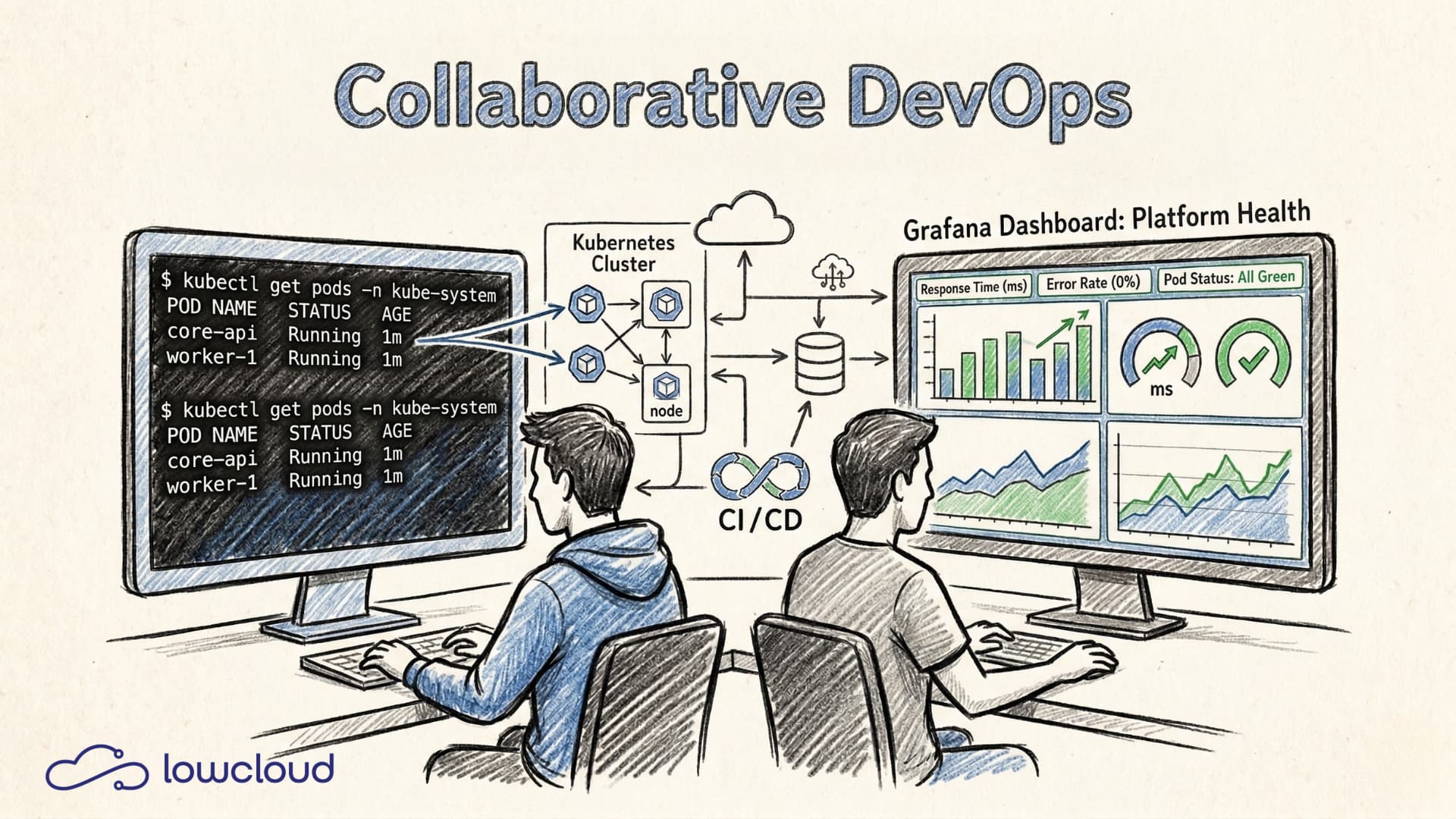
Collaborative DevOps: How Modern Teams Build Cloud Apps Together
Most deployment problems don't originate in the code. They emerge in the gap — between the moment a developer merges their branch and the moment the change runs stably in production. That's exactly where responsibility is unclear, communication breaks down, and teams pursue different goals.
Collaborative DevOps is the attempt to close this gap structurally. Not with a new tool, but with shared responsibility, common processes, and infrastructure that doesn't hinder collaboration but actively enables it.
Why Traditional DevOps Often Fails at Organizational Boundaries
DevOps as a term has existed for almost twenty years. Yet in many organizations, development and operations still work largely in silos: Dev writes code and wants to release fast. Ops runs systems and wants stability. Both goals are legitimate — but without shared processes, they lead to a structural conflict.
The classic symptom: code gets "thrown over the wall." Developers deploy to staging, the ops team takes over for production, and when something goes wrong, the finger-pointing begins. This isn't a failure of individuals. It's the predictable result of structures that cut off responsibility at a boundary.
The problem scales with team size. A two-person startup can do DevOps implicitly because everyone knows everything. A company with twenty development teams needs explicit structures — otherwise each team does DevOps its own way, which in practice often means: not at all.
What Collaborative DevOps Actually Means
Collaborative DevOps isn't a methodology with certification. It's a working model built on two core principles: shared ownership and transparent processes.
Shared ownership means a development team isn't just responsible for the code, but for the entire lifecycle of its application — from the first commit to running in production. This is the "you build it, you run it" approach that Werner Vogels of AWS described back in 2006, and that is still rarely implemented consistently in practice.
Transparent processes mean that infrastructure, deployment workflows, and operational parameters are visible and understandable to everyone involved. No knowledge locked in the heads of individual ops staff. No deployment that only one specific person can trigger.
Shared Responsibility in Practice
In day-to-day work, shared responsibility means developers participate in on-call rotations, set up monitoring themselves, and don't delegate incident response. In the short term, that's extra work. In the medium term, it leads to teams building software that's easier to operate — because the people who build it also bear the consequences of running it.
A side effect that's often underestimated: developers who've been woken up at night because of an incident write better logs afterward.
Observability as a Common Language
A central building block for Collaborative DevOps is observability. Logs, metrics, and traces must be equally accessible to both developers and ops teams. If only the ops team can access production data, genuine collaboration is structurally impossible. Developers never have a complete picture of how their applications behave at runtime.
This doesn't mean everyone needs to see everything everywhere. It means the tools for collaborative debugging exist: a dashboard both teams use, alerting rules both teams know, and a shared language for describing failures.
GitOps as the Technical Foundation for Collaborative DevOps
Cultural principles need technical tools that support them. For Collaborative DevOps, GitOps is currently the clearest concept.
The core idea: the desired state of the entire infrastructure and all applications is described in a Git repository. Changes are treated like code — as pull requests, with reviews, with versioning. An operator in the cluster (Flux or ArgoCD are the most common) continuously reconciles the actual state with the target state from the repository.
This has several direct effects on collaboration:
- Traceability: Every infrastructure change is a commit. Who changed what and when is always traceable.
- Collaboration: Infrastructure changes can be proposed by developers and reviewed by ops teams — and vice versa.
- Self-healing: Manual changes to the cluster are automatically reverted because the operator restores the target state from Git. No configuration drift.
Infrastructure as Code — Making Infrastructure Readable
Infrastructure as Code is the foundation that enables developers to understand and co-shape infrastructure in the first place. When Kubernetes manifests, Helm charts, or Terraform configurations live in the same repository as the application code, a shared language emerges.
Ops teams can provide code reviews on application architecture. Developers can modify resource requirements and network configurations directly in a pull request. Knowledge spreads — instead of disappearing into silos and leaving the company along with employees.
Pull Requests as a Deployment Process
A pull-request-based deployment process is more than a technical detail. It's a social structure: every change that goes to production has been seen by at least one other person. This creates a safety net while simultaneously forcing communication between teams.
In practice: a developer opens a pull request that references a new image version in the GitOps configuration files. Someone from the platform or ops team reviews, comments if needed, and merges. The operator in the cluster detects the change and deploys. No ticket, no handover meeting — the process is the pull request.
Platform Engineering: When Collaborative DevOps Scales
Beyond a certain team size, the "every team does everything itself" model hits its limits. Not every development team can or should be deeply familiar with Kubernetes, monitoring stacks, and CI/CD pipelines. This is where platform engineering comes in.
The concept: a dedicated platform team builds and operates an internal development platform — an internal product that gives other teams the tools they need for autonomous work, without having to manage every detail of the infrastructure themselves.
The Platform Team as an Internal Service Provider
The crucial difference from a traditional ops team: the platform team is not a gatekeeper. It's a service provider. Its customers are the development teams. When a team needs a new environment, they should be able to create it themselves — not open a ticket and wait three days.
This requires the platform team to see its infrastructure as a product. With its own roadmap, its own feedback process, and a clear focus on developer experience.
Self-Service and Golden Paths
The practical tools for this are self-service portals and golden paths: predefined, tested routes for setting up a standardized environment. Not the only way, but the easiest and best-supported one.
A golden path for a new microservice application could automatically create a Kubernetes namespace, a CI/CD pipeline, a monitoring dashboard, and a staging environment — all from a template maintained by the platform team. Developers can get started without knowing how everything is wired internally.
Learning Culture and Handling Failure
Collaborative DevOps only works if teams can learn from mistakes without fear of blame. This sounds obvious. In practice, it's one of the hardest requirements because it presupposes a specific organizational culture.
Blameless post-mortems are the concrete tool for this. After every significant incident, the team analyzes together: What happened? What circumstances contributed? What can we change systemically to prevent it from happening again? The question "Who's at fault?" is absent from the process — not because nobody makes mistakes, but because blame blocks learning and doesn't prevent future failures.
The result of a post-mortem isn't a scapegoat but an action plan: a modified alerting rule, a new deployment validation, an added runbook entry. Knowledge that was previously trapped in an incident becomes system knowledge — and stays with the team even when individual members leave the company. For the structural side of this — why documentation fails and how IaC and runbooks lower the bus factor in DevOps teams — we cover that in a dedicated guide.
Collaborative DevOps on Kubernetes
Kubernetes is today's standard infrastructure for cloud-native applications — and at the same time a good example of what Collaborative DevOps can look like technically.
Kubernetes manifests are declarative: they describe the target state, not the steps to get there. This makes them readable for developers who want to understand how their application is deployed — without having to dive deep into shell scripts. At the same time, Kubernetes gives ops teams the control they need: resource quotas, network policies, access controls.
When both teams speak a common language in YAML and Kubernetes concepts, the technical foundation emerges for what Collaborative DevOps strives for culturally: everyone feels responsible for the overall system, not just their own area.
This does require, however, that Kubernetes complexity isn't simply dumped onto development teams. A common mistake when introducing DevOps: "Everyone does ops now" in practice means developers are supposed to become Kubernetes administrators on top of their actual work. This overwhelms teams and leads to poor outcomes on both sides. The full-stack developer reality today illustrates exactly this problem — when the "full-stack" label quietly absorbs nine distinct engineering domains.
The better solution is a platform that abstracts Kubernetes complexity where it doesn't add value, and makes it accessible where it's relevant. Developers should understand what a Deployment and a Service is. They don't need to administer etcd clusters.
How lowcloud Fits into Collaborative DevOps
Collaborative DevOps describes a target state: shared responsibility, transparent deployments, and operations that don't happen "somewhere else." In reality, this target often fails on two fronts: too much operational overhead for development teams and too little standardization across many services. This is exactly the gap lowcloud fills.
lowcloud is designed as Kubernetes DevOps-as-a-Service to make Collaborative DevOps practical rather than replace it:
- GitOps-based workflows instead of "ClickOps": Changes become cleanly versionable and reviewable, so deployments and infrastructure aren't tied to individual people.
- Self-service instead of ticket queues: Teams can spin up environments, deployments, and standard services themselves, without an ops gatekeeper becoming a bottleneck.
- Standardized building blocks (Golden Paths): Recurring patterns for build, deploy, observability, and operations reduce variance and make "the right way" easier than "any way."
- Platform as a product: lowcloud is the platform layer that abstracts Kubernetes complexity while keeping concepts relevant to teams (deployments, resources, logs, metrics) accessible.
This creates a setup where development teams can take ownership without becoming full-time Kubernetes administrators on the side — and where ops/platform know-how flows into reusable standards rather than ad-hoc support.
Conclusion
Collaborative DevOps is less a toolset than an organizational approach: responsibility doesn't end at the merge, but encompasses operations, stability, and learning from incidents. GitOps, Infrastructure as Code, and solid observability give this aspiration a technical form.
For this to scale in day-to-day work, you need standardization and self-service. Platform engineering provides the model — and a platform like lowcloud can accelerate implementation by providing the operational foundations out of the box.
Anyone who takes Collaborative DevOps seriously should therefore talk not just about culture, but about the structures that enable culture: clear processes, shared visibility, and a platform that makes teams faster instead of slowing them down.
If you want to implement Collaborative DevOps on Kubernetes without starting from scratch, you can build on platforms that already provide these foundations: GitOps workflows, self-service environments, integrated monitoring. lowcloud is a Kubernetes DaaS platform built for exactly this use case — with the goal that teams can build fast without having to manage the full operational complexity themselves. If you want to see what this looks like in practice, it's worth taking a look at the platform.
Simplify Kubernetes Configuration: The Path to Human-Readable Cloud
YAML is the real problem, not Kubernetes. How Helm, Kustomize, CRDs, and Platform Engineering make cluster configuration readable and maintainable.
Knowledge Documentation in DevOps Teams: How to Actually Reduce Your Bus Factor
Why documentation fails in small DevOps teams and how IaC, runbooks, and DaaS platforms actually lower the bus factor.